

When a Scissor Is Not a Scissor… It's a Shear: Inside a Sacramento Groomer's Kit
What a 20-year Sacramento groomer taught me about the tools touching your dog.
By Terra Ruiz, LFDM, CTDI — Canine Relationship Coach
Annie Warren
Groomer and owner, We Love Paws · Sacramento · grooming since 2005 · self-declared terrier queen
One of the professionals I vouch for on my Trusted Pet Professionals list.
The short answer
Grooming shears are not scissors. They are forged, hollow-ground blades that run $300 to $1,000 a pair, and a working groomer carries several types — straights, thinners, chunkers, curves. Annie Warren owns about twenty-five pairs. But her verdict on all of it: "It's not the scissors, it's the groomer."
This whole thing started with a chicken butt.
I bought a little pair of grooming scissors on Amazon — pretty colors — because my hen needed her fluff trimmed away from, let's say, the landing zone. Then my client Kim's dog Zane had his first-ever spa day with me. Zane is a wire-haired terrier mix and a "don't touch me" kind of dog, and if you have ever loved a scruffy little mixed breed, you know the coat: some hairs long, some short, wild and crazy in every direction, all of it somehow forming a pattern. (That's him — the handsome one on my Furry Fundamentals page.) After I scrubbed him, his collar had left a perfect set line where it had settled down between all those scruffy hairs. So I picked up those grooming scissors to be nice and tidy him up.
And the scissors felt different. There was a little notch for my thumb. When I picked them up, I somehow knew which hand they were made for. I caught myself squinting at the blades wondering: do these have a curve? Is there a right way up?
And then my brain went where it always goes: my husband's knife block. A steak knife, a fillet knife, a chef's knife, a boning knife — they all cut, but they are absolutely not the same tool. If knives work that way, what about the tools a groomer holds against your dog for an hour?
So I did what I always do now. I went and asked a real expert — my friend Annie at We Love Paws, who has been grooming Sacramento dogs since 2005. I pulled up a stool while she worked, hit record, and started asking every question a regular dog owner would actually ask. Not dumb questions. Just honest ones — the kind you only get answered if you are willing to be the least knowledgeable person in the room on purpose.
Which, it turns out, I was. Immediately.
Correction number one
Here is how far I got before Annie schooled me.
She had told me to hang on a minute. I did not hang on. I followed her back to the kitchen, already talking, while she was trying to eat — a fancy ramen bowl that smelled like heaven. And she was gracious about it, eating and answering, because that's Annie.
Then I told her the title I had already come up with. I was proud of it. I thought I was being clever: "When a Scissor Is Not a Scissor."
What I said: "When a scissor is not a scissor."
Annie put the bowl down. "Shears."
That's it. No softening, no well, some people say — just the correction, delivered flat, with the exact energy of someone who had been personally insulted. I might as well have pointed at a Lab and called it a Golden.
And she was right, so the title changed on the spot. When a scissor is not a scissor... it's a shear.
I am keeping every one of my mistakes in this article, and there are several, because if you are like me, you didn't know either. Annie and I are both queen bee types — our friendship runs honest and unvarnished in both directions — so this is what it sounds like when you hand an expert your ignorance and let her do something with it.
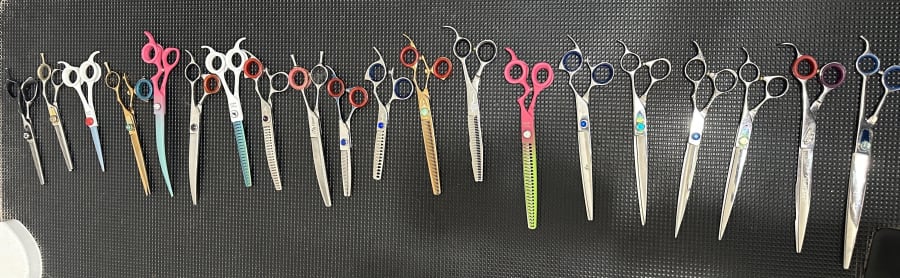
The shears in the case
I asked Annie about her first pair, expecting an Amazon story like mine.
Instead she walked me to a case. Her first shears were a gift from the woman who taught her to groom, and they were made in the 1950s — German steel, stamped Solingen, from the city they literally call the City of Blades. Annie still has them. Annie still uses them.
"They're sentimental," she told me. "But they still function."
She told me about taking them to an old sharpener years ago, who turned them over in his hands like she had brought him treasure: how did you get these?
I came to ask about equipment. Two minutes in, I am learning that a groomer's most important tool can be seventy years old, handed down like a family recipe, and still earning its keep on the table every week. Try that with anything you have bought lately.
And this is the part where I should warn you about me. I go looking for one small thing and come back four hours later holding something enormous. I did it with the vagus nerve. I have done it with genetics, with gut bacteria, with the mechanics of a leash. I came here to ask my friend where she buys her scissors, and I am about to spend an afternoon learning about German steel and carpal tunnel and the ethics of a shave-down. My husband no longer asks what I am reading.
I have made peace with it. The rabbit hole is where the good stuff is — it is where I find the thing nobody thought to tell you, which is the entire reason this blog exists. So: down we go.
What's actually in a groomer's kit
Annie kept grooming while we talked — this was a working interview — and walked me through the lineup.
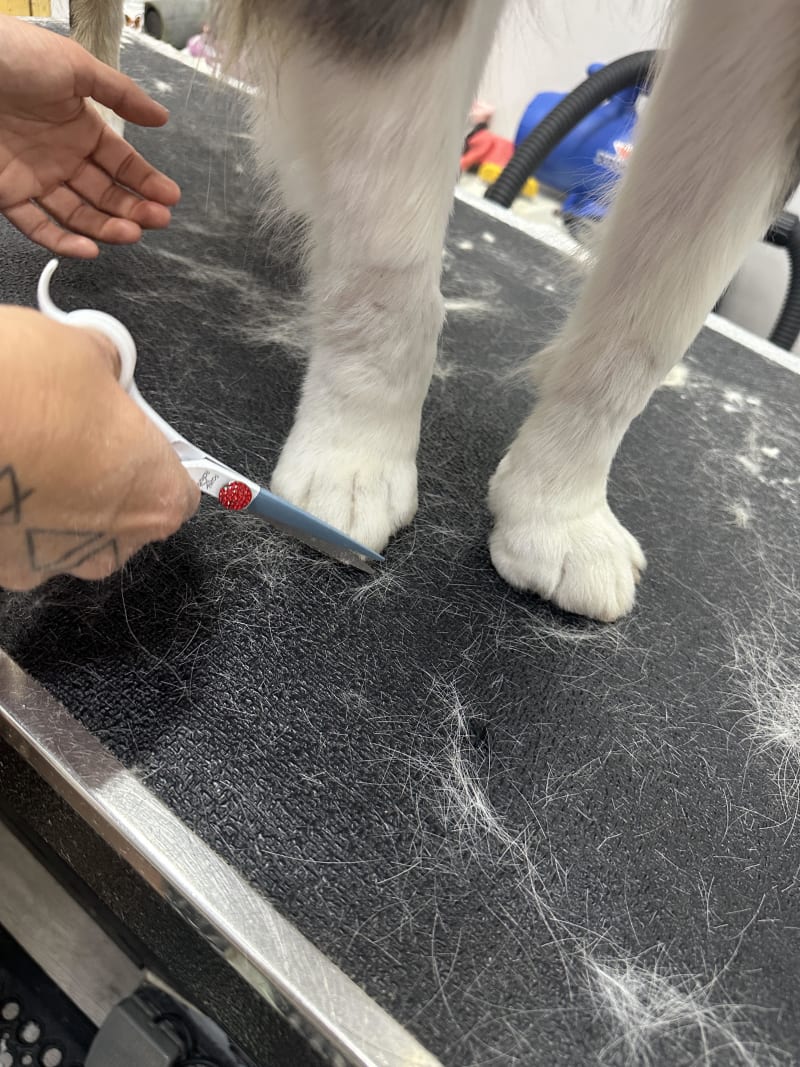
The small straights, doing feet. This is the close work.
Straights
The backbone. Long ones, around nine inches, are for hand-scissoring big jobs like standard poodles. They step down through eight inches all the way to tiny four-inch shears, "like hairdresser shears," for feet, faces, and small dogs.
Thinning shears
They look like a comb married a scissor. Hairdressers call them texturizers. They grab only some of the hair, for blending and softening.
Chunkers
The wide-toothed version. As the blade closes it only catches certain hair, so it takes out bulk without leaving lines. Then you follow with thinners to finish, because they take less.
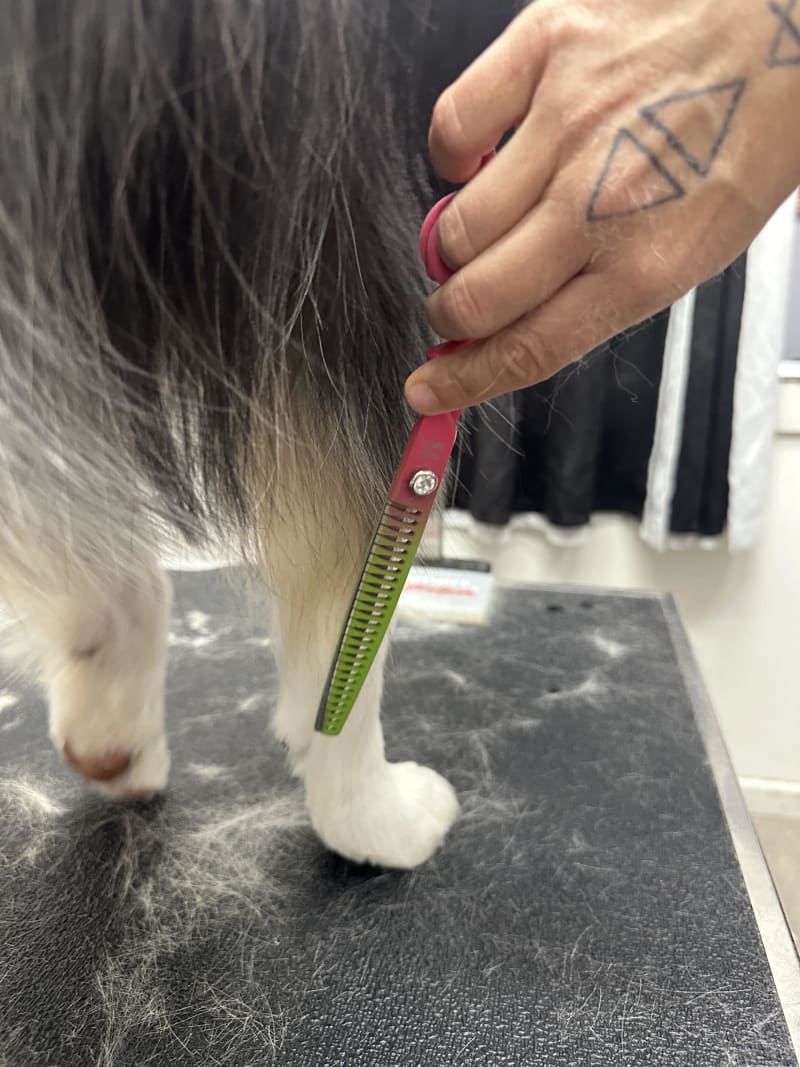
A chunker on Kiko. The wide teeth catch only some of the hair.
Curved shears
They exist, and when Annie handed me a pair I said, out loud, "these look like someone was drunk when they made them." They're for sculpting rounded shapes. And here is the part that surprised me: Annie barely uses them. Curves and chunkers are relatively new inventions — she figures they showed up in the last fifteen years or so. She learned on straights, twenty years ago, so straights are what her hands speak. "For old-season groomers, I just use straights."
What I learned to say this time
Tang — the little thumb notch I couldn't name.
Chunkers — wide-toothed shears that remove bulk without leaving lines.
Pelted — matting so severe the coat fuses into a sheet, like felt.
Solingen — the German city they call the City of Blades.
The fire question
"If you had to grab one pair in a fire — one — which is it?"
Her straights. No hesitation. Specifically her Sharkfins, the pair she just bought, about $300.
Let that number sit for a second, because I made her repeat it. Good shears run $300 to $1,000. A thousand dollars. For one pair. Japanese steel is the best you can get, she told me; German steel is second. Her everyday favorites over the last fifteen years: Sharkfin and Kenchii.
So when you drop your dog off for a groom, understand that the person on the other end has a rolling case that might be worth more than your first car, and every pair in it does a different job on your dog's coat.
And nobody touches them. Nobody. Her assistant once picked up a pair to open a box. Annie is still not over it. There is a separate pair of beat-up box-opening shears at the station for exactly this reason, a little graveyard pair, so the good steel never suffers.
"It's not the scissors, it's the groomer"
Here is where Annie ruined my whole premise, and it became the point of the article.
I asked, feeling clever: can you spot a cheap-scissor groom from across the room?
What I assumed: expensive shears make the haircut.
"Not necessarily. It's not the scissors, it's the groomer."
"It's not the scissors, it's the groomer."
— Annie Warren, We Love PawsCheap shears don't produce a bad haircut. They produce a slow one. They make the groomer's hands work harder to get the same result, like cutting construction paper with kindergarten scissors. A skilled groomer with mediocre shears will still send your dog home looking right. It will just cost her more, in time and in her body.
Which brings us to the part of grooming nobody sees.
The twenty-year wrist
Ask Annie what the wrong tools do to a coat and she will redirect you, because the coat isn't what's at risk. The groomer is.
Proper shearing technique means moving mostly your thumb, not your whole hand, not your wrist. Blow-drying, bathing, brushing: done wrong, it's all wrist, all day, for years. Done right, the power comes from the arm. (My massage therapy training said the same thing about hands versus body weight. Every hands-on trade seems to learn this lesson or pay for it.)
Annie knows a lot of groomers who burned out early — carpal tunnel, wrecked wrists — because nobody taught them to protect their body. And cheap shears make it worse: low-grade steel means your hand digs and forces its way through every cut, hundreds of times a groom, thousands of times a week.
When she says good tools buy longevity, she doesn't mean the tools' longevity. She means hers.
Feeding the shears
Annie sharpens every two to three months. And she trusts exactly one person to do it.
A bad sharpener, she told me, will "eat your whole blade." Sharpening works by grinding a thin layer of steel off the edge — that's the whole idea, you shave metal to expose a fresh edge. An inexperienced sharpener takes too much, or overheats the steel and burns it. Every bad sharpening permanently spends a piece of a shear's life. Spend enough of it and the thousand-dollar pair is gone. Not lost, not broken. Just used up by the wrong hands.
I will never look at a sharpening job the same way.
"Pay the bills": the doodle question
I asked what the doodle explosion has done to her kit and her work. Annie's complete answer: "Pay the bills."
And then we got into the thing every doodle owner needs to hear. You know how people swear they brush their doodle every day, but the coat is still matted, and then they are upset when the groomer shaves it short? I asked the question the way an owner would: why can't you just cut the mat out?
What I asked: can't you just cut the mat out?
"It's like unraveling a dread. You don't brush dreads out."
It depends how bad it is, Annie said, but severe matting isn't a tangle. The coat gets pelted: fused into a sheet, like felted wool, coming off in one whole piece. By the time a coat is pelted, the hair inside is dry, broken, and dead. You can technically de-mat some coats, but you are destroying the coat to save the length, and putting the dog through misery to do it.
The kind thing, at that point, is the shave-down. It isn't the groomer failing your dog. It's the groomer refusing to torture your dog for a hairstyle.
And if you are reading this with a freshly shaved dog and a knot in your stomach: a shave-down is a reset, not a verdict on you. The coat grows back. Doodle owners, in particular, are handed a coat that requires professional-level maintenance and almost no education about it, and that is not your failing. We all start somewhere. The only thing I ask of anyone is that we each get a little better at this than we were last year.
The part I will say to a breeder's face
Here is where I stop reporting and start arguing, because this one costs dogs their coats and their comfort, and I hear it constantly: "My breeder said wait until six months to start grooming."
I want to be careful here, because the person who repeats that line to me is almost never careless. She is doing exactly what the professional she trusted told her to do. So this is not aimed at her. It is aimed at the advice.
And the advice is wrong.
Find your groomer before you bring the puppy home — the same way you find your vet.
Then go every single week, before anyone ever picks up a shear.
The window where a puppy forms their opinions about the world closes early — around twelve to sixteen weeks, not six months. If the first time your doodle meets a grooming salon is at six months old, matted, for a two-hour appointment, you did not protect them from anything. You skipped the entire part where it could have been easy, and now a stranger is asking a half-grown, unpracticed dog to stand still on a table while a dryer roars at them.
And we never get that part again. Training can be redone at any age. Socialization cannot. That window opens once, closes on its own schedule, and does not reopen because you got busy or because someone told you to wait.
And socialization is easier than people think, because socialization does not have to mean engagement. It can be smelling, hearing, and seeing. Your puppy does not have to greet anybody. Go say hi to the groomer, get a cookie, and move on — that counts, and honestly it counts more than the version where everybody swarms your puppy.
The advice usually comes from a real concern — parvo, unfinished vaccines — and that concern has a solution that is not "wait." A field trip is not a groom. Carry the puppy in. Stay off the shop floor. Sit on your own towel in the lobby, eat some very good snacks while the dryers run in the background, let a groomer feed them a treat, go home. Five minutes. Every week. That is the entire assignment, and it is the difference between a dog who naps on the table at two years old and a dog who has to be muzzled for a nail trim.
You already do this without thinking for the vet, or at least I hope you do. The groomer sees your dog more often than the vet does, touches every inch of them, and does it with sharp tools running. Why on earth would that relationship get less preparation?
One more thing, and I mean it kindly. Look for a small, independent shop before you look at a big retail chain. High-volume environments are where a lot of brand-new groomers get their first reps, on a clock, with a queue. That is a hard place to learn patience, and a doodle coat is not a beginner's coat — it is one of the most labor-intensive coats in the business. You want the person who has been doing this for fifteen years and knows your dog's name. Ask around the same way you would vet a trainer's credentials.
If your breeder tells you to wait, ask them what they mean. If they mean "don't put an unvaccinated puppy on the floor of a busy salon," they're right, and field trips handle it. If they mean "don't start until six months," they are giving you socialization advice, not health advice, and it's wrong.
Consistency beats frequency
So I asked for her billboard message, the one thing she wishes every owner understood. Her answer surprised me with how forgiving it was: consistency. And not the drill-sergeant kind.
Annie doesn't care if your dog comes every four weeks or every twelve. She has clients who know themselves honestly — "I'm not going to brush this dog" — so the dog comes in like clockwork every twelve weeks for a full shave-down, grows out, comes back, repeats. That dog is fine. That schedule works, because it is a schedule.
What doesn't work is twice a year. The dog who shows up matted every six months isn't just getting a haircut. They are getting a marathon session on a body that hasn't practiced any of it: standing for the bath, standing for the dry, standing for the cut. Consistency isn't about the calendar. It's about the dog knowing the routine, and the coat never reaching the point of no return.
(One more piece of Annie technique I had never considered: you cut with the direction the hair grows. I had been snipping upward at my shepherd like I was giving him bangs. The professionals go with the grain.)
How to pick a groomer, from a groomer
Read reviews, yes. But then look at their Instagram — not for pretty pictures, for specialty. Groomers have breeds they love and breeds they have mastered, and the difference shows. Annie calls herself a terrier queen: she loves the feisty little ones. Doodles at her shop go to Jen, the doodle queen, because Jen knocks them out of the park. A shop that knows who is best at what, and routes dogs accordingly, is a shop that is thinking about your dog and not just the booking.
Match the groomer to the dog, not just the zip code. If that sounds exactly like how I talk about training — matching the approach to the dog in front of you — it's because it's the same truth wearing an apron.
Nobody is checking
Here is the part that surprises people, and it is the reason the specialty question matters so much: California does not require a license to groom dogs. No state exam. No board. No required training. A city business license and a seller’s permit if you sell shampoo, and that is the list. Someone can open a grooming business tomorrow morning having never touched a dog.
Certification exists — groups like the National Dog Groomers Association of America and International Professional Groomers run real programs — but every bit of it is voluntary. California tried once, back in 2012, with a bill called SB 969, and even that one only proposed a voluntary certification council. It didn’t pass into licensing.
I am not throwing stones. Dog training is exactly the same — anyone can call themselves a trainer tomorrow, and plenty do. It is why I am so specific about which of my credentials are certifications and which are just courses I took.
What it means for you is simple. When nobody is checking, you have to check. That is what the reviews are for, and the Instagram, and the specialty question, and asking a groomer flat out how long they have been doing this and what they are best at. Annie has been at it since 2005 and will tell you in about four seconds which breeds she loves. That answer is the credential.
And yes, I noticed: the woman who taught me all this is a self-declared terrier queen, and this entire investigation started because of a scruffy little terrier's haircut. Zane would like it on the record that he inspired an article, even if he would rather nobody touched him during it.
The moment the shears go down
And then I asked the question I had been saving: when does she stop? What is the point where a groomer puts the shears down and says this dog needs something else first?
Annie grinned. "I send them your way."
"I send them your way."
— what a good groomer says instead of forcing itShe meant it literally, because Annie refers dogs to me. But listen to the criteria, because this is what a good groomer sounds like: she stops when a dog is so panicked or defensive that she can't safely get a tool near them. When continuing would mean someone gets hurt, the dog or her. She doesn't muscle through it. She doesn't call the dog bad. She recognizes that what is on the table isn't a grooming problem, it's a behavior and emotional-state problem, and no shear in the case fixes that.
This is where my world and Annie's overlap, so let me put on my trainer hat for a minute.
A dog who panics at the groomer isn't being dramatic. Grooming asks a lot: a strange place, restraint, loud dryers, vibrating clippers, handling of paws and face. For some dogs that stack of stressors blows straight past what they can cope with. A shave-down after matting can genuinely hurt, too — pulling, tender skin underneath. Some dogs handle a fast in-and-out mobile groom just fine; others need what Annie builds into her days: real breaks, a chance to settle. Especially the seniors, who can physically collapse from standing through a full groom without one. Same service, very different dogs.
The trainer's read: what's really on the grooming table
| LLearning | EEnvironment | GGenetics | SSelf |
Your dog's coat is genetics — what they were bred to grow. The salon is an environment most dogs never get to practice. Comfort with handling is learned. And pain, age, or fear is self. When a dog struggles at the groomer, all four are usually in the room.
L.E.G.S.® is the framework of Kim Brophey — familydogmediation.com
This is also not theoretical for us. My lead trainer, Alex, spent years as a full-time professional groomer before she trained dogs for a living. She has stood exactly where Annie stands, with a dog who does not want to be handled and a clock running. That background is a large part of why cooperative care is something we take seriously rather than something we mention.
The fix isn't force, and it isn't sedation by default. It's preparation: teaching the dog, ahead of time and at their pace, that handling, tools, noise, and the table are survivable — even good. That's cooperative care, it's some of the most rewarding training I do, and dogs change. Annie and I have shared a few of these projects, including Erin's littermates, Roscoe and Marley. Marley was fine from the start. Roscoe, the Shih Tzu, was the one who needed a month of patient work before a face trim was possible, and he's a regular now. "He's like a different dog," Annie said, and there is no better sentence in either of our jobs.

If your dog struggles at the groomer, that is not a life sentence, and you are not stuck choosing between a matted coat and a traumatic day. It's trainable. It's actually one of my favorite things to train.
What's next
As I packed up, I asked Annie if there was anything I didn't ask that she wished people knew. She didn't hesitate, and she didn't say brushing. She said combing.
What I said: isn't there just... a comb?
Coarse, fine, super-fine, paddle, deshedding rake. There is a right tool for a given coat.
But here is the part that stuck with me, and it's what I tell my own clients now. We all say "brush your dog." A brush makes a coat look pretty and fluffy and finished on the outside. A comb is what tells you the truth. Think about your own hair: grabbing a brush is faster and easier, but if I am going to get a comb through it, I have to actually work every knot out first.
Same with your dog. Brush them, sure — then take the appropriate comb and make sure you can pass it cleanly all the way through the coat, down to the skin. If the comb won't go through, the coat isn't done, no matter how good it looks.
That is the whole ballgame on matting, and it's why we're definitely having the combing conversation next. Annie is already planning it. This is what happens when you interview your friends: they start assigning you sequels.
Questions people ask
How much do professional grooming shears cost?
Quality shears run $300 to $1,000 per pair, and groomers carry several types for different jobs. Japanese steel is considered the best, German steel second.
Why can't a groomer just cut the mat out of my dog's coat?
Severe matting fuses hair into a felt-like pelt. De-matting a pelted coat breaks already-dead hair and is painful for the dog. A humane shave-down and a fresh start is usually the kind option.
When should I start grooming my doodle puppy? My breeder said wait until six months.
Start before the puppy comes home by choosing a groomer, then visit weekly for short, no-grooming field trips. A puppy's socialization window closes around twelve to sixteen weeks, well before six months. If vaccines are the concern, carry the puppy in and stay off the shop floor — a field trip is not a groom.
How often should my dog see a groomer?
Consistency matters more than frequency. A predictable schedule, whether every four weeks or every twelve, keeps the coat manageable and lets your dog learn the routine. Twice-a-year marathon grooms are the hardest on everyone.
My dog panics at the groomer. Do I just have to live with that?
No. Grooming tolerance is trainable through cooperative care, gradually teaching your dog that handling, tools, and the salon are safe. Ask your groomer whether they offer breaks during sessions, and consider working with a trainer before the next appointment.
Next time: combs
Annie says you are probably brushing when you should be combing. That's the next conversation.
Work with me on grooming comfortRelated reading
- Down the Vagus Nerve Rabbit Hole With a Very Happy Dog — the last time I fell in this far.
- The Mr. Rogers Hack — preparing your dog for new experiences.
- Charge the YES — the marker that makes cooperative care possible.
Thank you to Annie Warren of We Love Paws in Sacramento, grooming since 2005, for the interview, the shears, and the corrections. Wholistic Canine serves Sacramento, Folsom, Carmichael, Fair Oaks, Citrus Heights, Rancho Cordova, and Arden-Arcade.