
Before You Call Your Dog Lazy: The Quiet Signs of Pain
What a Sacramento rehab vet taught me about the dogs we call lazy, stubborn, or grumpy.
By Terra Ruiz, LFDM, CTDI — Canine Relationship Coach
Dr. Lesley Scheblein, DVM, CCRT, CVAT, VSMT
Owner, Thrive Animal Rehabilitation · Sacramento · UC Davis School of Veterinary Medicine, 2010 · certified in canine rehabilitation, veterinary acupuncture, and spinal manipulation
One of the professionals I vouch for on my Trusted Pet Professionals list.
The short answer
Most pain in dogs doesn't look like limping. It looks like a dog who stops greeting you at the door, hesitates before jumping on the couch, won't eat from a bowl on the floor but will from your hand, or gets snappy when you move them. Dr. Lesley Scheblein, a Sacramento rehabilitation veterinarian, puts it plainly: it is exceptionally rare that she examines a dog and finds nothing that hurts.
"It is exceptionally rare that I don't find something that's not right."
— Dr. Lesley Scheblein, on examining any dog at allI did this interview wearing sunglasses indoors
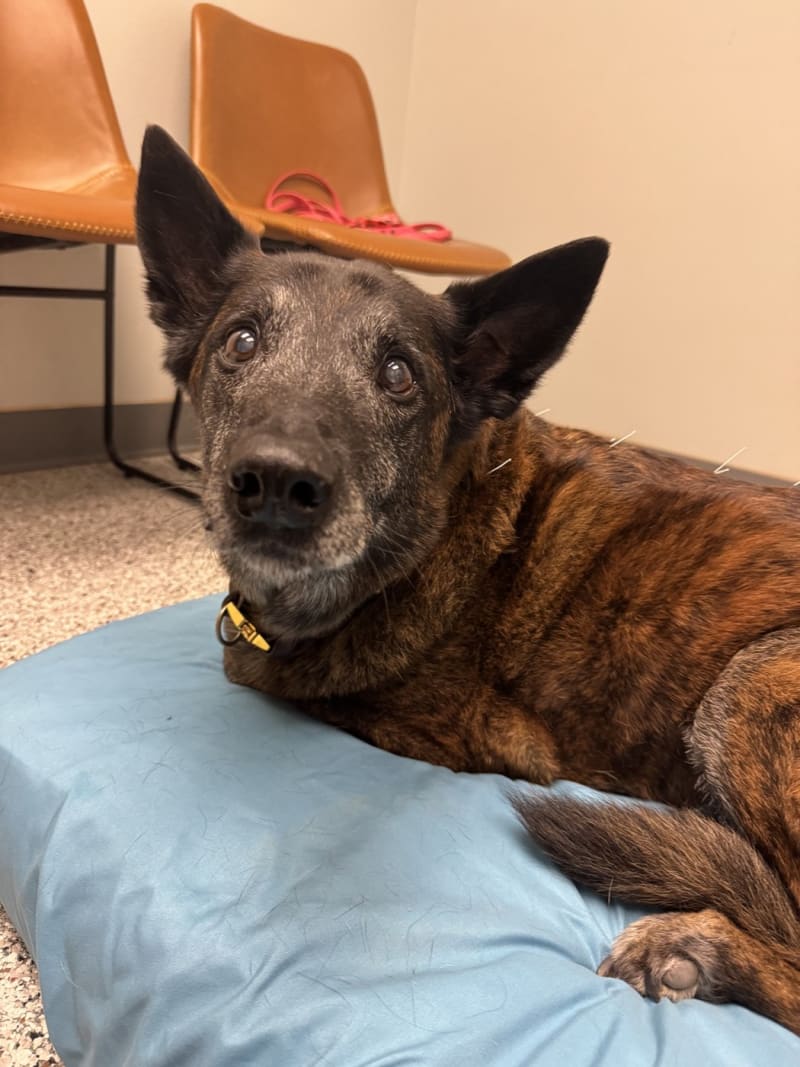
My dog Charlie is fourteen. Twice a month he goes to Thrive Animal Rehabilitation for laser therapy and acupuncture, and on the day of this interview I did both things at once — Charlie on the mat getting his treatment, me on the floor next to him with my recorder and twelve questions.
What I did not think about is that when the laser is running, everyone in the room wears blackout goggles.
So there I am, sitting on the ground in sunglasses so dark I cannot read my own interview notes, holding the paper two inches from my face. At one point I gave up and said: I'm going to give you some questions that are on here, I know we're going to run out of time, but you just guide me where you think you go.
That is the level of professionalism you’re getting today.
Correction number one
This one happened near the end of our conversation, but I'm putting it first, because it's the thing I had been getting wrong long before I walked in the door.
I said something about physical therapy for dogs.
She stopped me. Not rudely — she's not a rude person — but firmly, the way you correct someone who's about to publish a thing.
What I said: physical therapy for dogs.
"I do physical rehabilitation and spinal manipulation. Those are our words because they're protected."
"Physical therapist" and "chiropractor" are job titles attached to specific human licenses. In California, only someone licensed by the Physical Therapy Board can use the title physical therapist or the letters P.T. Chiropractic has its own board and works the same way.
That distinction matters, because a veterinarian's license is broad. A regular vet can give your dog a massage and there's nothing improper about it — vets are licensed to work on animals, full stop. Dr. Scheblein has gone and gotten three rehabilitation certificates anyway. What she cannot do is borrow a title that belongs to a different profession's license.
Which is why she says physical rehabilitation and veterinary spinal manipulation. Not because the terms are fussier, but because the other two are somebody else's name.
I had been saying it wrong out loud, to clients, for years.
The restriction is on the word, not the work.
And it isn't just vocabulary — it's the law
Dog training is not regulated. Anyone can call themselves a dog trainer tomorrow morning. No license, no board, no exam, no title anybody is protecting. It's why I'm so specific about what my certifications actually are and what they aren't, and why I think every owner should ask.
So sitting on the floor of a clinic, talking to someone whose entire profession is built on licenses and protected titles, I wanted to know how it works on her side. The protected words come with protected rules, and I asked her to spell them out so I wouldn't get them wrong. Here's her answer, word for word:
Read that twice if you're shopping for bodywork for your dog. A human chiropractor or physical therapist can work on your dog in California — but only with a veterinarian who has examined your dog, decided it needs the treatment, decided the treatment is safe, and who is on the premises while it happens. Not on call. Not available by phone. There.
So if someone is adjusting dogs in a parking lot, at a trial, or in your living room, that is not how this is supposed to work.
I'm not telling you that to scare you. Bodywork for dogs is having a moment, the marketing is everywhere, and most owners have no idea there's a rule at all — which is exactly the position I was in ten minutes before she explained it. I've had someone come to my house and adjust my own dogs. I did not know then what I know now, and I'm not going to name anybody, because none of this is about getting a person in trouble.
What I would ask you to do is go in with your eyes open, because the risk lands on you and the person you invited over.
Who is responsible if something goes wrong? Not in a lawsuit sense — in a practical one. If your dog is worse the next morning, who do you call, and what can they actually do about it?
What do you tell your vet? Because you should tell them. A treatment your vet doesn’t know about is a hole in your dog’s record, and holes in the record are how things get missed later.
What does your pet insurance actually cover? Ask before, not after. Policies differ enormously on who has to perform a treatment for it to be covered.
So what is it, then?
"Veterinary rehab, I would say, is looking at the body, talking more about muscles, nerves, and connective tissues than general medicine."
"It's not looking at, I have a broken bone. It's looking at what happens around the broken bone."
— Dr. Lesley Scheblein, on what veterinary rehabilitation actually isRegular medicine treats the thing that broke. Rehab treats the body that has been limping around, compensating, bracing, and overloading the other three legs while the thing that broke gets better.
She got into it through the seniors. Not the athletes, not the surgical cases — the old dogs.
"I felt like pain management could be addressed from a different way than just necessarily always a pill. I think a multimodal approach to pain includes body work, includes alternative therapies like laser, includes exercise. I'm thinking about longevity and feeling good for as long as you can. And I think that a lot of older dogs just get a pain pill as their only option, and I wanted something besides that."
The toolbox: laser therapy, shockwave, acupuncture, spinal manipulation, manual therapy on muscle and fascia, therapeutic exercise, and an underwater treadmill for dogs too weak, too sore, or too post-operative to carry their own weight on land.
The room is different, and the dogs know it
This is the part I notice every time I walk in with Charlie. It's quiet. Nobody is crying.
You know the sound I mean — somebody's dog in a kennel in the back, one of the big feelers, leaking those little sad cries into the lobby. I'm in a kennel. I'm alone. I don't have my mom. It soaks into every other animal in the building, including yours, before anyone has touched them.
That sound is not in this room. She's built it that way on purpose.
"We don't even carry — I don't have thermometers. I have a stethoscope for if I need it. But the general dog doesn't get the things that are scary like that."
And then the line I think about constantly:
"They start to drag their owners in. I have more and more clients that say my dog usually doesn't want to get out of the car at the vet, but when they get here, they're pulling me in the front door."
They also get a lot of cookies, she told me. Which is the part a dog is actually keeping track of.
What I learned to say this time
Protected title — a job title the law reserves for people holding a particular license. The work may be perfectly legal for someone else to do. The name is what's reserved.
Physical rehabilitation — what Dr. Scheblein does. She uses this term because physical therapist is a protected title in California, and that license is for treating people.
Veterinary spinal manipulation (VSMT) — adjusting an animal's spine. Chiropractor is a protected title too, so a veterinarian doing this work calls it spinal manipulation instead.
Multimodal — treating pain from several directions at once instead of one pill.
Proprioception — the body's sense of where it is in space. She tests it by turning a paw under and seeing whether the dog notices.
Pain wears a behavior costume
This is why a dog trainer is writing about a veterinarian. Two dogs come up over and over, and both arrive with a label already attached.
The young dog who’s “lazy”
A breed that should be unwalkable. The dog you stereotypically cannot tire out. And he doesn’t want to go.
What the owner says:
“He just doesn’t like to go.”
What Dr. Scheblein says:
“No, no, no. There’s something wrong.”
And a lot of those dogs, she told me, were born with the hips or the elbows that are doing it to them — hip dysplasia, elbow dysplasia, the things a dog arrives already carrying.
That word is hereditary, and it is going to matter enormously in a few minutes, so hold onto it.
The old dog who’s “aggressive”
A young dog walks past. Doesn’t touch him. Doesn’t try anything. And the old dog goes after him. No toy. No resource. Nothing you would expect to explain it.
What it actually is:
“They’re protecting their bubble because they don’t want to get bumped.”
And it isn’t always about pain that is already happening: “Maybe I’m unsteady on my feet. Maybe I’m not necessarily gonna hurt, but you might knock me over, and then I might hurt.”
That’s a dog doing math. Not a dog being bad.
The list — what to actually look for
September is Animal Pain Awareness Month, declared by the International Veterinary Academy of Pain Management, and the entire point of it is that people are watching for the wrong thing.
"Everyone thinks a limp is how they know their dog is painful."
Here is what she watches for instead. Read this part slowly, because I guarantee somebody reading it is about to recognize their own dog.
The quiet list — what she watches for
• The couch. They always got up next to you. Now they don’t.
• The door. They always greeted you there. Now they stay on the bed and wag.
• The bowl. They won’t eat off the floor, but they’ll eat from your hand.
• The counter. A cat who used to jump up now circles it, working out another way.
• The pause. They stop and think before doing a thing they’ve done a thousand times.
• The absence. Or they just don’t do it at all.
• The face. Changes in the expression. How they’re holding their ears.
Her summary of the whole list: "not doing things that they normally would do, or thinking twice before they do it."
And then she told me about the couch.
"My cat, I thought he was just getting older and more respectable. And he stopped scratching my couch. And then I started giving him a pain injection. And suddenly he was tearing my couch up again. And it turned out it just hurt his elbows to scratch on the couch. And once I treated the pain, he started doing the bad thing. And I just thought he was mature, but really, he didn't do it because it hurt."
Notice the shape of that story, because it runs backwards from how we normally read our animals.
The behavior improved — and that was the bad news. A cat who stops wrecking your couch looks like a cat who finally grew up. He was actually a cat whose elbows hurt too much to do it.
The destruction came back — and that was the good news. Good news for the cat, anyway. Bad news for the couch.
There's a version of this in every house. Sometimes after treatment, the dog doesn't look dramatically different, but the old habits come back. They go get the ball. They squeak the lamb chop at you again.
"It's like, okay, you're feeling like yourself again."
"Hereditary" and "genetic" are the same word
Remember the young dog who wouldn’t go for a walk — the one born with the hips that were doing it to him? This is where that matters, because I think this is where owners lose the thread.
People file hereditary somewhere separate from genetics, like they're two different topics — hereditary is something about the family, genetics is something about a lab. So I asked her straight out: when you say hereditary, you're also saying genetics, right?
"Yes. And there's a lot of breeds that are known to have predisposition to different disease processes."
Her three examples, off the top of her head:
- German Shepherds — hip dysplasia
- Retrievers — elbow dysplasia
- Dachshunds — long spines, which raises the risk of spinal injury
Nobody did anything wrong to those dogs. They were built with it, and it was handed to them by the dogs they came from.
That's also how she knows a young dog's problem is hereditary rather than an injury: "You should not have abnormally shaped joints when they're born." So when a nine-month-old Lab has an elbow full of arthritis, the question isn't what happened to him. The question is what he was born with — and, if you're a breeder, which two dogs produced it.
This matters for one enormous practical reason: if it's genetic, it's screenable. You can look for it before a dog is bred. You can look for it before you buy a puppy. Nobody can screen for bad luck, but this isn't bad luck.
It isn't just old dogs
Ask most people who gets arthritis and they'll say old dogs. She sees two other groups constantly.
The athletes. Agility, flyball, dock diving, the whole world of dogs with jobs — including the ones doing it for fun: "Sometimes they're weekend warriors and they go to agility once a week and they go insane and then they're sore afterwards, because they're doing it for fun, they're not doing it to try and compete."
Both ends of that spectrum get hurt — the elite dog because the jumps are bigger, the weekend dog because nothing prepared the body for Saturday. And the thing nobody does:
"As a person we know we should stretch and we should do these things, but dog people don't always think about that, because the dog will keep doing it whether you do these things or not."
Warm up. Cool down. Stretch. Nobody does it. The dog never asks for it, because the dog never says no.
The puppies. She's currently treating a nine-month-old Labrador, bred to be a show dog, who was limping badly by eight months. X-rays showed one elbow already full of arthritis.
Nine months old.
"That dog is a Lab that's happy and wagging. He's going to chase the ball if you throw it, but he's going to look bad afterwards."
And here's the part I want to be careful about, because it would be easy to read this as a story about a bad breeder. It's the opposite. The moment those X-rays came back, that dog came out of the breeding program, and his mother is being spayed — because they know it's hereditary and they're not going to pass it along.
That is a breeder doing exactly what a breeder is supposed to do with bad news. Hold that thought.
The hybrid vigor conversation
Here's where I got to tell a story on myself, and on my husband.
Before he was my husband, Brandon was a potential client. He called me and told me he didn't want a purebred German Shepherd because he didn't want all the genetic problems. I spent about thirty minutes on the phone explaining why that logic doesn't work, and then I returned his money.
(Reader, I married him.)
Dr. Scheblein says the same thing, professionally:
"There's people that go to the pound and they get themselves a dog that's supposed to have hybrid vigor, and then it still has bad elbows."
Because those elbows came from somewhere. A joint is built to a blueprint, and the blueprint came from the two dogs who made this one. Mixing two dogs together doesn't overwrite that. It just means nobody looked at either blueprint first. "Nobody genetically tested or did screening X-rays of these two dogs running around the street that then had a litter of puppies that then ended up in the shelter."
Then she put a point on it that I'm going to steal forever. When you go to the shelter and pick the dog who looks like a German Shepherd —
"He has some purebred German Shepherd in there somewhere. That's why he looks like one."
The predisposition came with the look. And a dog carrying a bad hip passes it on whether or not anyone ever gave it a name — that's how a problem travels through generations of dogs nobody was screening.
"People just assume that it's a purebred problem. And it's not just a purebred problem."
What a responsible breeder actually does
I asked her to define it from her side of the table — not from the training world, from the exam room. Her answer was one sentence: people who are trying to better the breed, not just make more dogs.
In practice that comes down to testing, waiting, and being willing to lose a dog from your program when the results say so. Here's what the testing involves.
| Screening | What it looks at | What you should get |
|---|---|---|
| Hips | X-rays, taken once the dog is physically mature | An OFA or PennHIP score you can look up |
| Elbows | X-rays for abnormal joint formation | An OFA score |
| Eyes | An exam by a veterinary ophthalmologist | A dated exam result |
| Heart | A cardiologist exam, or an echocardiogram | A result, not a general-practice “sounds fine” |
| Breed-specific genes | A DNA test for the known problem in that breed — the SOD1 gene in German Shepherds, for instance | A lab report showing clear, carrier, or at risk |
| Thyroid | Bloodwork, for breeds where it matters | A dated panel |
Two things about that table matter more than the rest of it.
The waiting. Hips and elbows can’t be screened in a puppy — you have to wait until the dog is physically mature. Which means a breeder doing this properly is holding off on breeding a dog they already own, already love, and already paid for, on the chance the X-rays come back bad.
The paperwork. A breeder shouldn’t just tell you they tested. They should hand you the document, with a score on it. "Not only are they saying they did it, but they can also give you a score. You can have excellent, good, fair, poor. You can also be pass or not pass."
OFA results are searchable by the public, so you can verify it yourself before you ever meet a puppy. If someone says yes, we test and can’t produce a single piece of paper, you have your answer.
And it means removing dogs from the program when the screening says to — which is exactly what happened with the nine-month-old Lab. That dog is out. His mother is being spayed. That is what it looks like when someone is actually doing this.
Coming up in this series
This is a veterinarian’s view of breeding, from the end where the problems show up. I want the other end too — a breeder who does all of this, in their own words, explaining what it costs and why they bother. That interview is on my list. If you are that breeder, or you know one, come find me.
What an evaluation actually is
I asked, half-joking, whether there's some big machine a dog lies down in. There is not. It's her hands — and a little rubber hammer, if she needs it.
She goes over the whole dog, top to bottom, focused on the orthopedic and neurologic systems: range of motion, tightness, pain, and if there's a limp — which leg, how bad, and what makes it worse. Everybody gets a full neurological exam, because orthopedic and neurologic problems look alike from the outside.
The neuro tests are beautifully low-tech. Turn the paw under and see whether the dog fixes it. Shift their weight and see whether they catch themselves. Tap the knee and watch for the kick, the same way your own doctor did it when you were a kid.
And then she said something that genuinely delighted me: "They don't know that there's a right answer and a wrong answer, which is wonderful for us."
Think about the eye doctor. One or two? Two or three? There is enormous stress in being tested when you believe there's a right answer. Dogs never feel one second of that. They can't study for it, can't fake it, and can't tell you what they think you want to hear — which makes them honest test subjects in a way people simply are not.
The case she’s proudest of
I asked whether there was a case she was proud of. There was, and it belongs to a dog in my own field — so let me give you the ending first.
Earlier this year
Hopping on three legs. Would not use the fourth at all.
Amputation was on the table — a real conversation, about really taking her leg.
Now
Walks a mile. Swims. Has some off-leash freedom back.
On the leg everyone was ready to give up on.
The patient is a border collie owned by Bridget, one of the dog trainers at My Clever Canine over in Dixon — another outfit on my Trusted Pet Professionals list. After multiple knee surgeries and a complication that would not heal, rehab hit a wall: the kneecap slipped out of place and would not go back.
Here is the whole reason I refer to Dr. Scheblein. She stopped. This was not a rehab problem anymore — the knee was structurally wrong — so she sent the dog to a surgeon to have it put right. No pride about it, no stretching it out over another month of appointments. Only after the repair did rehab have something solid to build on: shockwave to push the stubborn bone toward healing, and the underwater treadmill so the dog could practice walking without carrying her own weight.
And when I asked what made the difference, she didn't credit a machine. She credited Bridget — who had an easier, cheaper road available (dogs do fine on three legs, and nobody would have blamed her) and didn't take it. She brings that dog in every single week. The dog kept her leg.
"She may not be hiking up mountains, but she didn't want her dog to have to lose a leg because they couldn't get it better. She is a rock star."
The full story — every surgery and setback, and what it cost to get there — deserves its own post. It's on my list.
Jojo, and the referral I almost didn't make
Jojo is a mini dachshund — and before anyone's heart stops, no, not the JoJo longtime readers met on this blog. Different dog, same great name. I've been this Jojo's trainer since he was about eight weeks old.
His behavior was getting worse. He was startling awake and snapping. He was making poor choices. And if you touched him wrong, you could see it — real, intense pain.
Here's my confession, and it's the reason this post exists.
I did refer him out. I referred him to his regular vet, the way I always do, because that's easy and that's the reflex. And the regular vet didn't find it. Sometimes a regular vet doesn't notice, or the dog has been braced and guarded at every visit for years, and it reads as just how this dog is.
A rehab vet is a different skill set looking at a different question.
What I've changed since: when I send a dog to any vet now, I send details. Not "he seems off." I see this dog move, in the place he lives, for an hour at a time. "He's been stalling at the second step for three weeks, and he only snaps within the first minute of waking up" gives a vet somewhere to put their hands. "He seems off" gives them nothing. That's the job the trainer can do that nobody else in the dog's life can.
After Dr. Scheblein found the pain, I rebuilt how we handle Jojo around what she found — a predictable pattern he can say yes to before hands ever lift him. That protocol deserves its own post, and it's coming.
He gets about twelve acupuncture needles every three weeks. Some dogs don't mind them. Some feel every single one, and I was genuinely worried about which one Jojo would be.
"Now, I mean, he comes in every three weeks. And they have noticed a huge difference in his demeanor. They said he's happy. Happier than he's ever been."
I could not have imagined this dog falling asleep on a table. He now starts relaxing before the needles are even in.
Correction number two — the stairs
I'd had Jojo's stair problem filed under he's a mini dachshund and stairs hurt. One standard human-height step and he'd stop dead, no matter how badly he wanted to follow you. His FOMO is considerable and it still didn't move him.
I said out loud that I used to think it was just because he's little.
What I assumed: he avoids the stairs because it hurts.
"Not only is it just, it may hurt to do it, but what if I don't make it?"
That's not a pain calculation. That's a risk calculation. He's not refusing because it hurts — he's refusing because he might not land it, and then it will hurt. The dog is running a whole assessment I hadn't credited him with.
Also worth knowing: dachshunds' long spines raise their risk of spinal injury. That's not a knock on the breed, it's the shape of the breed.
The Chuck-It confession
The most generous thing she said all day was about her own dog, years before she did rehab.
He'd jump out of the car and she'd immediately start throwing the ball full speed, as far as the Chuck-It would send it. No warm-up. Straight from sitting in a vehicle to sprinting. At seven or eight, he pulled a groin muscle.
"He went after that ball, he yipped, he left the ball, turned around and came to me. Everything about him said, I hurt."
"I mean, for that dog to choose to not go get the ball is huge."
— Dr. Lesley Scheblein, about her own dogRead this twice
A ball dog leaving a ball is a five-alarm fire.
If your dog has one thing in this world they would cross a freeway for — the ball, the frisbee, the leash coming off the hook — and one day they turn it down, do not wait and see. That is the loudest thing your dog can say without words.
She changed his whole life after that — stretching, massage, acupuncture, laser, and a completely different kind of outing. Short, low throws. He still got to have some of it. He just never got the crazy version again.
This connects to something I've been telling clients for years: don't play fetch until your dog physically cannot continue. She confirmed it, and added the part I don't say well enough — a high-drive dog will not protect itself:
"They'd run into a tree to get the ball. They would jump off a cliff to get a ball and not think about what might happen on the other end. They make bad choices because their instinct and their desire or work ethic says, well, you told me to. You threw that ball. I'm gonna get it no matter what."
Your dog is not going to tap out. That decision is yours.
(This is the same thing I went down a rabbit hole about with a Springer Spaniel who has no middle gear — arousal is arousal, and a happy dog in a high state can't feel what a calm dog would. That post is here.)
The thing she wishes every owner knew
I asked what she wishes every dog owner understood, and I expected her to name a treatment. She didn't mention one.
She said she wishes people thought about the body before there is a problem. Not after the limp. From the beginning, in the ordinary parts of a day nobody thinks to count.
The jumps nobody counts
The bed — Up in the morning, down at night, and every time you move.
The couch — Their favorite spot, and the landing is hardwood.
The tailgate — Out of a truck, onto pavement, carrying their whole weight.
The car — Every single trip, twice.
The back step — Forty times a day, because the door is right there.
None of those are injuries. Every one is a small impact, absorbed by a joint, repeated for years. And because your dog can do it — cheerfully, at speed, without complaint — nobody ever questions whether they should.
"Just because you can doesn't mean you should."
A ramp off the bed. A step at the couch. Lifting the small dog out of the car instead of letting them launch. Every one of those is boring, none of them feel urgent, and all of them are cheaper than a knee.
Ramps and steps are not for old dogs.
They’re for the dog you’d like to still have when they’re old.
Why Charlie was on the table
Charlie is fourteen. He gets laser and acupuncture once or twice a month, and he's been getting it long enough that the appointment is just part of his life.
He had a major surgery, and afterward his skin got badly irritated. We couldn't work out whether the flare-ups were skin or pain, and the answer turned out to be both — they feed each other. When his skin flares, his back end struggles, and he's already working with a bad knee and probably an elbow.
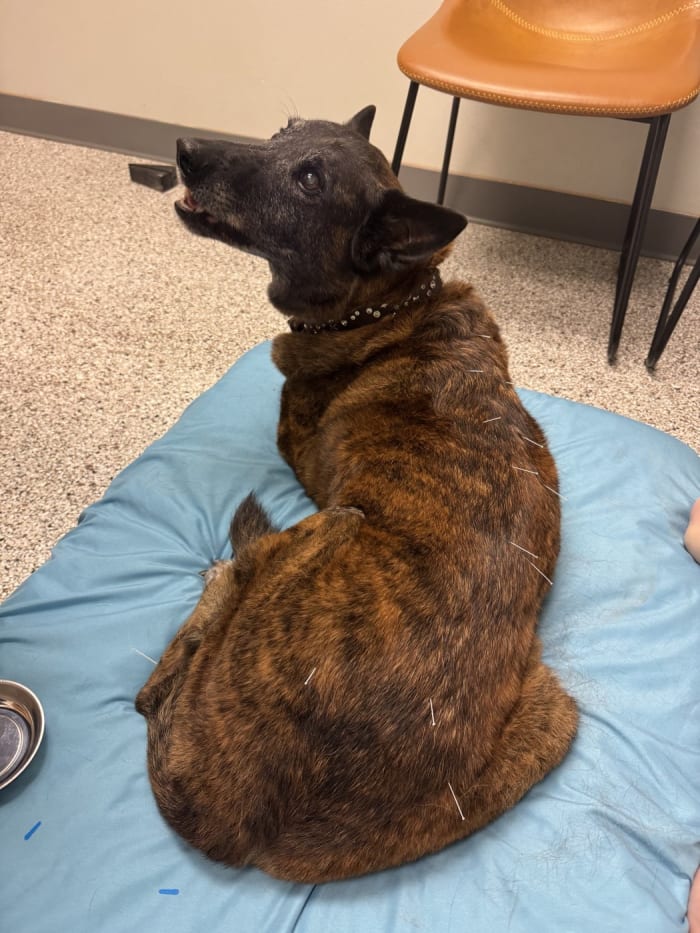
He is, to put it plainly, falling apart. He is also doing remarkably well, and the reason is that he's maintained by a team instead of rescued by an emergency.
That's what I want you to take from this post. Not that your dog is broken. That the work is ongoing, unglamorous, and it starts before the crisis.
The trainer's read: all four letters are in the room
| LLearning | EEnvironment | GGenetics | SSelf |
Learning — Jojo discovered that hands arriving without warning meant pain, so he learned to snap first. Now he's learning a predictable pattern instead. Both of those are learning. One of them we taught him by accident.
Environment — stairs built for human legs, a couch that's too tall, a bowl sitting flat on the floor. A dog's whole world is surfaces somebody else chose.
Genetics — the letter people skip. The hips, the elbows, the length of a spine, handed over by the two dogs who made this one.
Self — the individual animal right now. Charlie at fourteen. Jojo with his own wiring. Same breed, same age, different body.
Pain sits in three of those four letters at once, and gets diagnosed as a problem in the fourth.
L.E.G.S.® is the framework of Kim Brophey — familydogmediation.com
Questions people ask
How do I know if my dog is in pain?
Watch for what's stopped, not just for limping: no longer greeting you at the door, hesitating before jumping on furniture, eating from your hand but not from a bowl on the floor, stopping before a normal movement, or getting snappy when touched or moved. A rehabilitation veterinarian can evaluate what you're seeing.
Can pain look like a behavior problem?
Yes, and often does. Dogs labeled lazy, stubborn, grumpy, or aggressive are frequently protecting a painful body. A young dog who won't walk and an old dog who snaps at a passing puppy can both be pain cases.
Is my mixed-breed dog safe from hip and elbow problems?
No. "Hybrid vigor" doesn't erase genetics. If a shelter dog looks like a German Shepherd, there's German Shepherd in there, and nobody screened the parents.
What is veterinary rehabilitation?
Treatment focused on muscles, nerves, connective tissue, and how the body moves — using laser, shockwave, acupuncture, spinal manipulation, manual therapy, therapeutic exercise, and an underwater treadmill — rather than treating an isolated injury in isolation.
Can a human chiropractor adjust my dog in California?
Only under the direct supervision of a California-licensed veterinarian, who must first examine the animal and establish that the treatment is needed and safe, and who must remain on the premises while treatment happens.
Is your dog stubborn, or sore?
If something about your dog has changed and nobody can tell you why, that's worth a conversation.
Book a session with Wholistic CanineRelated reading
- Down the Vagus Nerve Rabbit Hole With a Very Happy Dog — arousal, and the dog with no middle gear.
- The Mr. Rogers Hack — why predictability changes everything.
- Trusted Pet Professionals — the short list of people I send my own clients to.
Thank you to Dr. Lesley Scheblein of Thrive Animal Rehabilitation in Sacramento for the interview, the corrections, and for taking care of Charlie. September is Animal Pain Awareness Month. Wholistic Canine serves Sacramento, Folsom, Carmichael, Fair Oaks, Citrus Heights, Rancho Cordova, and Arden-Arcade.