

What JoJo Taught Me About Thresholds, Tools, and Freedom in Dog Training
Quick Answer
When should a trainer consider an e-collar?
Only once the dog already understands and can perform the behavior you're asking for. An e-collar is not a teaching tool — it's used at the lowest level the dog can actually feel, to reinforce a skill the dog already knows. If the dog doesn't understand the cue yet, the tool is not the answer.
At a Glance
- The dog: JoJo, a Chinese Village Dog imported from China, rehomed after aggressing toward caregivers entering his elderly owners' home.
- Where we started: Reward-only, always. Ten private sessions, weekly to every other week, before he would let me touch him.
- Where we pivoted: A one-month board and train, adding off-leash recall and e-collar work.
- Where he landed: Reliably off-leash by the time he went home, joining group walks and attending events and parties.
- The lesson: No single method fits every dog. You build the right toolbox for that dog, that owner, that environment.
JoJo was the hardest dog I have ever worked with, and he is the reason I train the way I do now. He got the whole book thrown at him. What he taught me wasn't a technique. It was that no single approach is enough on its own.
Who is writing this: I'm Terra Ruiz, owner of Wholistic Canine in Sacramento. I've been training dogs professionally since 2012 and I'm a Licensed Family Dog Mediator®, trained in Kim Brophey's L.E.G.S.® Applied Ethology framework.
JoJo's case sits right in the middle of that timeline. I took him on shortly after completing Mark McCabe's Training Between the Ears, and I earned my Family Dog Mediator® license while I was still working his case. He is a large part of why I pursued it. More on our certifications and credentials here.
JoJo's Story — A Dog at His Limit
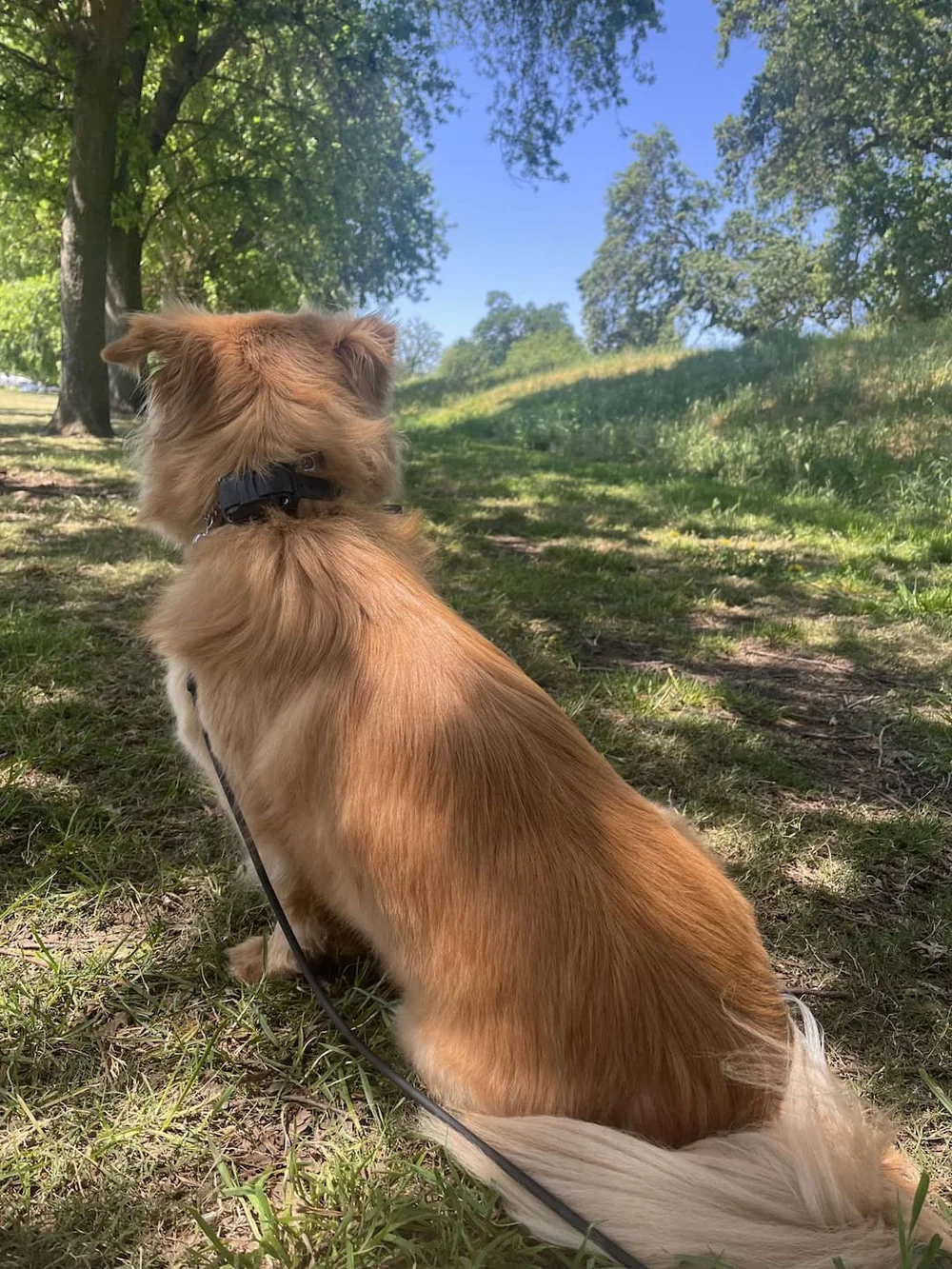
JoJo was a Chinese Village Dog. I don't know exactly how his original family came to have him — maybe they rescued him off the street, maybe he just became part of their life in China. Eventually they moved to the United States. Years later, as they aged into their 90s, JoJo started reacting aggressively to anyone who entered their home. They needed caregivers. He wasn't safe around them. So he was placed in a rescue, and adopted by Sunny — who would go on to become one of my closest friends.
I took his case in the most confident stretch of my career. I had just finished Training Between the Ears and I came back fired up. New framework, new lens, new plan. I thought I had the answer.
I started him the way I start every dog: reward-only. That is always where I begin.
Ten private sessions later — weekly to every other week, some in his home, some outdoors — he finally let me touch him. Just touch. That was the milestone.
What JoJo Had Already Been Through
Before anyone asks why he was like this, look at what his life had been.
He was likely pulled off the streets in China. Then transported across the world to a country where nothing smelled, sounded, or moved the way it was supposed to. He landed with an elderly family whose needs eventually outgrew what he could tolerate. Then he went into rescue — where he was put in with a group of dogs, which overwhelmed him past the point of coping until he shut down.
And then he was sold.
I use that word on purpose. We say "adopted" because "purchased" sounds horrible when we're talking about a living thing. But money changed hands for a dog, same as it does from a breeder or a rehoming post. One version gets treated as more ethical than the other. It's still a transaction.
Here's why the word matters, and it isn't semantics: "adoption" lowers your guard. Nobody buys a dog from a breeder without asking questions. But adopting feels like a good deed, and good deeds don't feel like they require homework. So people skip the hard questions — what is this dog's actual history, what has he already learned, what am I equipped to handle — and find out the answers at home.
That's what happened here. He went to someone who wanted a cute, fluffy dog to love on, and had no idea what she was actually taking home.
I'll say the next part directly, because pretending otherwise doesn't help anyone: when a dog and a person are that badly matched, it can become an abusive relationship — in both directions. Not because the dog means it. JoJo never meant it. He was doing the only thing that had ever worked for him. But the person on the other end is chronically afraid in her own home, bracing every time the doorbell rings, and that leaves a mark that outlasts the dog. Meanwhile he's over threshold nearly all the time with no way to say so except with his teeth. Nobody in that house is okay.
She loved him completely. Both things are true at once, and that's the part our industry doesn't talk about enough.
Reading JoJo Through L.E.G.S.®
Partway through JoJo's case I earned my Licensed Family Dog Mediator® credential and trained in Kim Brophey's L.E.G.S.® Applied Ethology framework. L.E.G.S. asks you to look at four things before you look at behavior: Learning, Environment, Genetics, and Self. Brophey describes observable behavior as the tip of an iceberg — everything driving it sits underneath, out of sight. JoJo is the clearest example I have of why that matters.
Learning — This is where I had it wrong at first. I thought of learning as the reward history we were building. But JoJo arrived with a learning history of his own, and it was a good one — for him.
He was guardy, protective, and genuinely insecure about people entering his space and putting hands on his people. Somewhere in that old house, he learned that going snarly and rude worked. He'd escalate, the person would back off, and the discomfort would stop. That's a clean, well-rehearsed pattern, reinforced hundreds of times over years. Nothing about it is dominance or attitude. It's a dog who found the one strategy that reliably made a scary thing go away, and got very good at it.
So we weren't teaching a dog with no plan.
We were competing with a plan that had never once failed him.
Environment — He lived in an upstairs unit above a busy urban center, with no quiet transition between his front door and full sensory overload. Stepping outside was the trigger. We even tried having him potty indoors to skip the street entirely; he held it for hours instead, waiting for the walk he expected.
Ethology gives us two terms that explain the rest. Flight distance is how close a threat can come before an animal chooses to move away. Critical distance is how close it has to get before the animal attacks instead. Every animal has both. In an apartment stairwell, on six feet of leash, JoJo's flight distance was violated constantly with no option to retreat — which pushes strangers straight into critical distance.
Under threat, an animal can fight, flee, freeze, or appease. Take flight off the table and you've narrowed the list to three, and you've taught the dog which one works.
Genetics — In Brophey's framework, JoJo was a World Dog — one of the ten genetic groups. World dogs aren't a breed anyone designed. Nature did the selecting, on the edges of human settlements, for one job: being good at being a dog. Self-sufficient, opportunistic, observant, running their own agenda.
Here's the part most people don't know, and it's in Brophey's own course material: most dogs on this planet aren't pets at all. They're free-ranging village and street dogs. JoJo wasn't an exotic case. He was a completely normal dog who got moved into an abnormal situation.
Self — He was an older dog who arrived already fully formed, with a history attached. He never liked toys. He never cared much about play. He wasn't a blank slate and never pretended to be one.
All four were working against us before I ever opened my treat pouch. That's what a method alone can't fix.
Why Reward-Only Wasn't Enough
Brophey uses a lock-and-key image for this: a dog's genetics are the key, their environment is the lock, and when the key doesn't fit, you get friction. That friction is what most people call a behavior problem.
Mark McCabe's Training Between the Ears gets at the same thing from the training side. He teaches learning in two layers. First you build the pieces in order — you can't do algebra before arithmetic. Then you build emotional tolerance, gradually, under increasing pressure. He uses driving as the example: you learn the car in an empty parking lot, then quiet streets, then busy streets, and only much later the highway.
JoJo had no parking lot.
He lived on the highway.
That's the honest answer to why reward-only didn't get us there, and it isn't a failure of reward-based training. It's that every single session started at maximum difficulty, because his front door opened directly onto the hardest environment he'd ever face. There was no easier version to build from.
He wasn't stubborn. He was stuck — emotionally, physically, behaviorally.
And I was stuck too.
That's the part trainers don't say out loud often enough. Sometimes the limitation is genetics. Sometimes it's environment. Sometimes it's the owner's capacity. And sometimes it's the trainer — your tools, your experience, the ceiling of what you personally know how to do at that moment. With JoJo, all four were live at once. I had to be willing to say that the plan I was so excited about wasn't going to be enough on its own.
The Turning Point: A Month of Board and Train
After months of private work, JoJo came to my board and train for a full month. That's when we brought in balanced methods — off-leash recall and e-collar work.
What he needed wasn't more obedience. He needed freedom. He needed to know he could leave a situation instead of being trapped at the end of six feet of nylon. And he needed that before he had any chance of coping in a normal environment.
The irony: when JoJo arrived, I had been seriously considering stepping away from e-collars entirely.
He's the reason I didn't.
When a Tool Is Actually the Right Call
An e-collar is not a teaching tool. That's the whole thing, and most of the argument on both sides misses it.
The tool comes in after the dog already understands and can perform what you're asking — used at the lowest level the dog can actually feel, just enough to reinforce a skill that's already there. If the dog doesn't know the behavior yet, the tool isn't the answer. It's noise the dog can't interpret.
It's the same logic as the parking lot. You don't add pressure until the foundation exists. Adding it earlier doesn't speed anything up — it just teaches the dog that the world is confusing.
Do I offer e-collar work to every client? No. Do I market it? No.
When I use something this nuanced, it's because it's the right dog, the right owner, and the right situation — all three. It's not about pushing a button. It's about teaching a language that includes choice, control, and the ability to remove yourself from something overwhelming.
The Part Nobody Says Out Loud About E-Collars
E-collars are one of the most controversial tools in the dog training world, and I'm not going to pretend otherwise or talk you into one.
So let me say it plainly: nobody has to learn or use this tool. It is not a requirement to be a good trainer or a good owner. There are excellent trainers who will never touch one, and their dogs are fine.
If you do go this route, understand what you're signing up for. This isn't a tool you buy and figure out. It requires advanced training and real proficiency at reading your dog:
- You have to read body language fluently — not "he looks happy," but actually fluently.
- You have to know when your dog is trying and when he isn't. Those look different, and the difference is everything.
- You have to know why he's making the choice he's making, not just what he did.
- You have to read the room — the environment, the people in it, what's about to happen next.
That's true whether you're using vibrate, tone, or the static function. All of it requires understanding. And the better you are at reading your dog, the faster the dog gets to the answer.
Can a trainer walk you through this? Yes — that's exactly what a good board and train should do, and what we do. But the handoff is the whole thing. If you finish the program and don't understand what's happening and why, you don't have a trained dog. You have a dog who behaves for someone else.
On the "it's just easier for the trainer" argument: people say that, and there's truth in it. Clear boundaries are easier. Yes means yes and no means no, and the dog stops guessing. Take a dog who jumps on the glass door. You can work that through other channels, and you can get there, but it takes a long time. Sometimes a simple vibrate ends it, because the information finally arrived in a form the dog could act on immediately.
With JoJo, that's what it looked like. Not punishment. Information. Hey — knock it off. Don't go eat that dog. You know better. Come to me. We're going to hang out, we're going to have fun, we are amazing.
And yes, I said "eat." He was reactive toward people, but he was worse with dogs. That's the conversation we were having. The tool was just how the sentence got delivered.
Leash Laws vs. Real Dog Needs
People ask, "Well, what about leash laws?" I get it.
Dogs are domesticated, yes. But no dog was born expecting to spend its life tethered to a human by six feet of nylon. We built that system.
And we need leash laws, because not everyone can control their dog. Some dogs have no social manners. Some owners ignore boundaries. Structure exists because too many people wouldn't follow the rules otherwise.
But my goal isn't chaos. It's structured freedom.
When I teach off-leash skills, I always start with a long line. Never without a helper tool. A fifteen-foot line is my go-to — long enough that the dog gets real room to make choices, short enough that I can manage it and get to the dog if I need to. That's still freedom. It's controlled freedom, with a safety net.
They're not off-leash yet. But they're learning what it feels like to be.
The Owner Who Changed the Environment
Here's the part of JoJo's story I bring up most with clients, and it has nothing to do with training.
Sunny bought a house for her dog.
She was living in an apartment in a college-town area — the exact environment drowning him. Parking lot potty trips. Constant foot traffic. No decompression anywhere. So she bought a townhouse away from all of it, with a small yard of his own, so he never had to walk out into that again.
She built him a parking lot.
Environment is one of the four legs of L.E.G.S. for a reason. You can run the best training plan in the world and still lose to a bad environment. Sunny didn't just do her homework — she changed the setting the homework happened in. That's what made the training stick.
Not everyone can move. But almost everyone can change something about the environment, and it's usually the highest-leverage thing available.

What JoJo Became — And What He Didn't
By the time he went home, JoJo was reliably off-leash. He joined group walks with other dogs. He came to events. He came to parties at my house — once he understood that the people in those rooms were going to ignore him and let him be.
That last part is the key, and it's worth saying plainly: the goal was never to make JoJo love strangers. The goal was to build him a life he could actually participate in.
He never became a social butterfly. He never cared about toys. He wasn't especially interested in going out and having fun — honestly, he was a little boring and a little lazy.
He did love food.
That's a real outcome. Not a transformation into a different dog. A well-managed dog with a bigger world and an owner who finally understood him.
The Mistake
I'm including this because leaving it out would make his story dishonest.
Later in his life, JoJo bit someone.
The person had been sitting on the ground and stood up fast, right in front of him. They had been told exactly how severe his history was. They didn't listen.
Look at what that is. Someone inside his critical distance, moving suddenly, with flight unavailable from a seated position at close range. Those are the precise conditions that built his original strategy in that old house. He didn't invent something new that day. He went back to the plan that had never once failed him.
That's what "managed" means. The old pattern doesn't get deleted. It gets outcompeted, as long as everyone holds up their end.
And here's my part: that person was a trainer, so I gave them latitude I wouldn't have given anyone else. That was my error, not JoJo's.
Managed is not cured. A behavior case doing beautifully is still a behavior case. Your job — as the handler, and as the trainer in the room — is to advocate for the dog every single time, including when the person not listening has credentials. Especially then.
How JoJo Found His People (And So Did I)
JoJo grounded all the fire in me.
Working his case, Sunny and I went from trainer and client to genuine best friends. We worked together so much and so hard that there wasn't really another outcome. I didn't just gain a client. I gained a friend.
I always joke that my husband ended up with me because his dog was so difficult he had no choice but to marry the trainer. Maybe JoJo was the same — so hard he brought two people together.
Goodbye, JoJo
JoJo passed in 2026. We believe it was his heart.
He was the hardest dog I have ever worked with, and one of my favorites, and those two facts were never in conflict.
Brophey's framework has a line I come back to constantly: behavior problems are normal responses to imbalanced L.E.G.S. JoJo was never a broken dog. He was a normal dog — the kind most of the world's dogs actually are — living in a situation that asked him for something he was never built to give. Once we stopped asking him to be a different animal and started changing what we could, he had a life.
He got everything I had. Every method, every framework, the kitchen sink. And what he taught me is what I now build every case on: you cannot use one method for a dog. You go into your toolbox and you build the right toolbox — for that dog, that owner, that environment, that moment.
Thank you, Sunny. For being a friend, and for giving me JoJo.
Common Questions About E-Collars and Reactive Dogs
When should a trainer consider an e-collar?
Only after the dog already understands and can perform the behavior being asked of them. An e-collar is not a teaching tool. It's used at the lowest level the dog can actually feel, to reinforce a skill that's already there. If the dog doesn't know the cue yet, the tool isn't the answer — it's information the dog can't interpret.
Are e-collars humane?
It depends entirely on the handler's skill and intent, which is why they remain controversial. Used to reinforce a known behavior at the lowest level the dog can feel, an e-collar communicates information. Used to teach, to punish, or by someone who can't read canine body language fluently, it causes harm. No one is required to use one to train a dog well.
What does "over threshold" mean in dog training?
A dog is over threshold when the environment has exceeded what they can cope with and they can no longer think or learn. They may bark, lunge, freeze, or shut down. Training does not work above threshold — the dog isn't being defiant, they've lost access to the part of the brain that learns.
What is critical distance in dog behavior?
Flight distance is how close a perceived threat can come before an animal moves away. Critical distance is how close that threat has to get before the animal defends itself instead. When a dog can't retreat — on leash, in a corner, in a stairwell — every approach pushes past flight distance and toward critical distance.
Can a reactive dog ever be trusted off-leash?
Some can, with the right foundation and honest assessment. JoJo was reliably off-leash by the end of his month-long board and train and joined group walks with other dogs. But off-leash work always starts on a long line — we use fifteen feet — and it requires an owner who will advocate for their dog every single time.
Does a board and train fix a reactive dog?
No program "fixes" a dog. A board and train can build skills quickly in a controlled setting, but the results only hold if the owner understands what changed and why. If you finish a program without that understanding, you don't have a trained dog — you have a dog who behaves for someone else.
Working with a dog who can't cope with their own neighborhood?
Reactive and fearful dogs need a plan built around their whole life — genetics, environment, history, and all. That's what we do.
Reactive & Fearful Dog Training in SacramentoA friend to your furry family,
Terra Ruiz, Wholistic Canine