

Once Trained Is Not Always Trained
Why is my trained dog suddenly misbehaving?
A trained dog can still break a rule he's followed for years — not because the training failed, but because his body, his age, or his environment changed. Training is a skill you maintain in conditions you manage, not a permanent setting you switch on once. Here's the day my own senior dog proved it to me.
I said it in another post and I'll say it again here, because it's the thing people most want to be untrue: once trained is not always trained.
People hear it and nod, and then they go right back to believing that training is a thing you finish. That the dog learned it, past tense, and now it's just a fact about him, like his weight or his color. It isn't. Training is a skill you maintain, in an environment you manage, with an animal whose body and brain keep changing on you.
The human parallel is easy enough. You learn to do long division a certain way in fourth grade and you'll probably do it that way forever — unless you never fully understood it in the first place, or unless someone hands you a calculator and the easier path wins. Skills drift. Skills get replaced by whatever's cheaper. Nobody thinks that's a moral failing in a person. It's just how learning works. Same for your dog.
Here's what happened at my house last week.
Meet Charlie
Charlie is fourteen. Deaf, or close enough — there's a little hearing left, but only if the conditions are perfect. He's got some gut stuff going on, and one of the things that comes with that is scavenging. He's hungrier than he used to be, or at least his body keeps telling him he is.
Charlie is trained. He does not counter-surf. We have had parties with food out across every surface in that kitchen and he has never once helped himself. There's a lower counter in our kitchen — think bar height, the kind of thing that's basically a table. If I left one of his toys on the edge of it, he'd take it. He knew his own things and he knew he was allowed to have them, and he'd be so careful about it — just his head coming up over the edge, nothing else, grab it, done. But food up there was never his, and he never once treated it like it was.
There's also a couch that backs up to the edge of that counter. He doesn't like that couch. Doesn't get on it even when I'm sitting right there. He's old, it's a whole production for him, it's not worth it to him.
So: trained dog, disliked couch, counter he's never once raided for food. I have left bread on the edge of that counter approximately a thousand times.
What changed
I was soaking the other dog's kibble.
(Quick aside, because it matters — if you feed kibble, letting it soak until it absorbs the water and softens is easier on the gut. The body doesn't have to break down a hard, dry pellet. Worth doing, especially for seniors.)
I don't normally leave a soaking bowl out and walk away. But we went to dinner, and I did.
And here's the part I want to be honest about, because it's the exact place my thinking went wrong: Charlie had already eaten. I fed him. His dinner was in him. In my mind that closed the loop — tummy handled, food on the counter is fine, no reason for him to care.
But a full bowl an hour ago doesn't switch off a nose. Kibble sitting in warm water for a couple of hours saturates the entire kitchen. Charlie is standing in a room that is screaming food is here, food is here, food is here — and he cannot find it. Can't get to it. There is no version of this dog with the athletic ability to do the acrobatics that bowl would require.
His stomach wasn't the problem. The information his body was getting was the problem — and I'd fed him in a way that made me stop thinking about it.
So he searches. And somewhere in the searching he gets on the couch — the couch he hates — because he's chasing the odor to its source. And on the counter next to the couch, at his exact level now, there are two bags of buns.
He ate part of one. Not even the whole thing. Just enough.
A real safety note on the bag. We got lucky. Dogs suffocate in food bags — they push their nose in, the bag seals around them, and they can't back out. It's happened to a trainer friend of mine. If your dog scavenges at all, the bag is the real danger, not the calories. Chip bags, bread bags, cereal liners — treat them like a hazard.
The tell
I get home. Charlie meets me at the door — which, for a deaf senior who sleeps through most arrivals now, is already odd. And he's excited. Tail going, standing right in the doorway, hi mom hi mom hi mom.
My first thought was that he needed to go out. This is a big behavior change, and big behavior changes mean something. So I walk the hallway toward the back door, past the living room — and there they are. Two shredded bread bags, spread across the couch. The couch he doesn't get on.
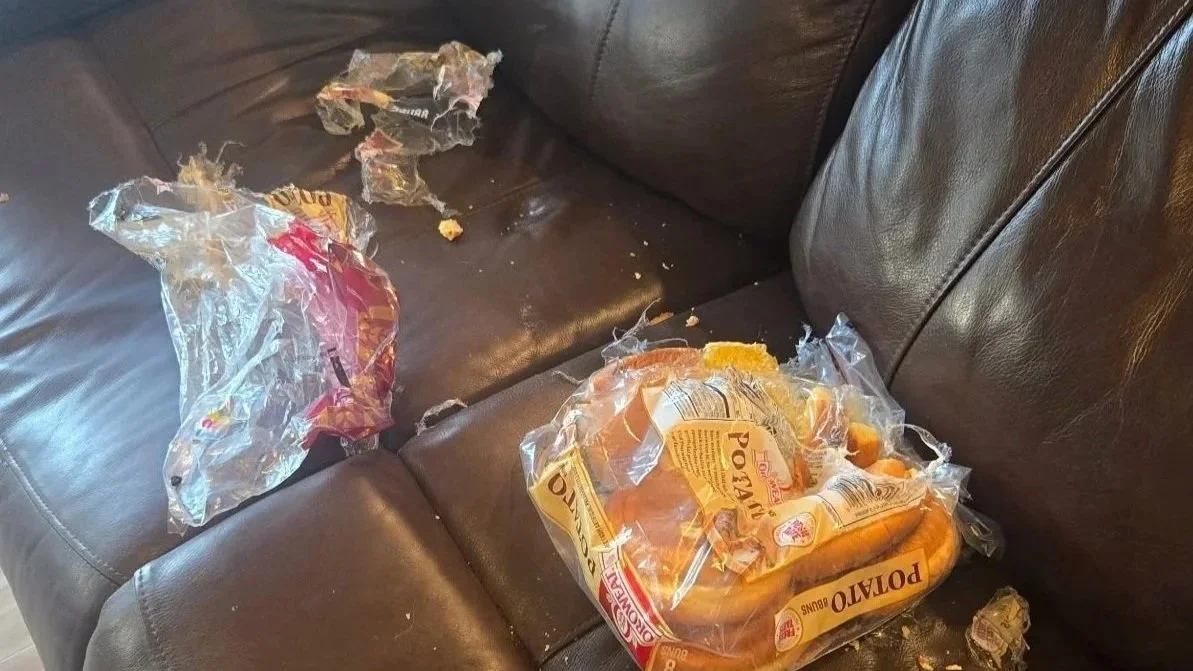
And I stood there going: okay. What was different? What changed?
Because that's always the question. Not why is he bad now. What changed.
Why a trained dog suddenly breaks a rule
Nothing about Charlie's training broke. He didn't forget. He didn't decide the rules don't apply.
What happened is that I introduced a condition he had never been trained in, in a body that isn't the body he was trained in. Strong food odor with no accessible source. An aging gut that keeps sending hunger signals whether or not he's just eaten. Me, out of the house for hours. Under those conditions he did what animals do: he searched, and the search happened to pay off.
That's the part people miss. He got rewarded — not by me, by the environment. He went looking for food and he found food. That's a reinforcement history now. It exists. He's a dog. Food isn't a preference for him, it's survival wiring, and survival wiring does not care what he knows.
This is exactly what the whole-dog approach is built to see. A dog's behavior is the product of his learning, his health, his environment, and his species-normal instincts all at once — not obedience alone. Change one input and the output changes, no matter how well he was trained on the old inputs.
What I'm doing about it
From now on, I don't leave food where Charlie can reach it. That's the whole intervention.
Could I use a correction instead? Sure — except a correction has to happen at the exact moment the behavior does. Which means I'd have to set him up to fail, or supervise him constantly, forever. I'm not interested in doing that to a fourteen-year-old dog who's just being a dog with a rumbly stomach.
So I'll clean my counter. He'll drift back out of the habit on his own. And in the meantime, management costs me nothing and costs him nothing.
What I actually want you to take away
This happens to trainers. We do all the things right, and sometimes there still isn't enough training in the world — you have to prevent it instead.
If you send your dog to a board and train and get him back knowing everything, that's real. It's not a scam and it's not fake. But it's not permanent either, because nothing is. If you don't maintain the skills and manage the conditions, you still have an animal living in your house. That is the hardest thing for people to grasp, and I say it as kindly as I know how: we will give you every skill, every tool, and show you exactly how to use them. You still have to use them.
For me, using them would have looked like not leaving a bowl of smelly soaked kibble on the counter next to a senior dog whose nose doesn't care that I already fed him — and then leaving the house for three hours.
Once trained is not always trained. Ask me how I know.
A friend to your furry family,
If your trained dog suddenly started doing something that isn't like him, there's almost always a what changed underneath it — and it's usually not disobedience. That's the kind of thing we help you untangle.
Frequently asked questions
Does dog training wear off over time?
Training doesn't erase itself, but it isn't permanent either. Skills fade without practice, and a dog's behavior can change when his age, health, or environment changes — even for a dog who followed a rule reliably for years. The reliable way to keep trained behavior is to keep practicing it and to manage the conditions around your dog, rather than assuming the lesson is locked in for life.
Why did my trained dog suddenly start counter-surfing or scavenging?
Usually something changed that the dog was never trained against. Common triggers include a strong food smell with no accessible source, a health issue that increases appetite (common in senior dogs), a new schedule, or a single successful raid that accidentally rewarded the behavior. The dog isn't being defiant — he's responding to new information, often driven by the survival-level instinct to find food.
Does a board and train program make a dog permanently trained?
No. A good board and train can genuinely teach a dog a lot in a short time, and that learning is real. But the skills still have to be maintained at home in real conditions. Without ongoing practice and environmental management, even a well-trained dog will drift, because he's still a living animal responding to his surroundings.
Should I punish my senior dog for getting into food while I was gone?
Correction only works in the moment the behavior happens, so punishing a dog after the fact — when you get home — doesn't teach him anything except that your return is unpredictable. For a one-off caused by a change you can control, the kinder and more effective fix is management: remove the dog's access to the food so the situation can't repeat.
Is it safe to leave food bags where my dog can reach them?
No. Beyond the risk of your dog eating something harmful, dogs can suffocate inside food bags — bread bags, chip bags, cereal liners — when they push their nose in and the bag seals shut. Store food out of reach and dispose of empty bags securely, especially if your dog scavenges.