
The Pilot Walk: Why the Calmest Thing on the Leash Should Be You
A Sacramento dog trainer digs into the toolbox and shares one of the best things in it
The short version: The Pilot Walk is a concept from Kim Brophey's Family Dog Mediation framework: when you and your dog move through the world, you're the pilot and your dog is the passenger. The catch most people miss is that the biggest thing you control isn't your dog — it's your own nervous system. Get calm, get present, and your dog's headspace follows yours. The goal isn't to control your dog forever; it's to build enough trust that they can earn a copilot seat beside you.
I'll be straight with you about why I'm writing this.
As a Licensed Family Dog Mediator, I have access to some genuinely brilliant frameworks for understanding dogs. And it has started to bother me that they mostly live in binders and course materials. These tools don't do anyone any good locked away where only trainers can see them. So I'm digging them out and sharing them with the world, one at a time.
Today it's one of my favorites: the Pilot Walk. You've got the gist from up top — you're the pilot, your dog's the passenger. Simple to say. Here's what nobody tells you about actually doing it.
Pilot Mode Doesn't Start at the Sidewalk
Most people think the walk starts when their feet hit the pavement. It doesn't.
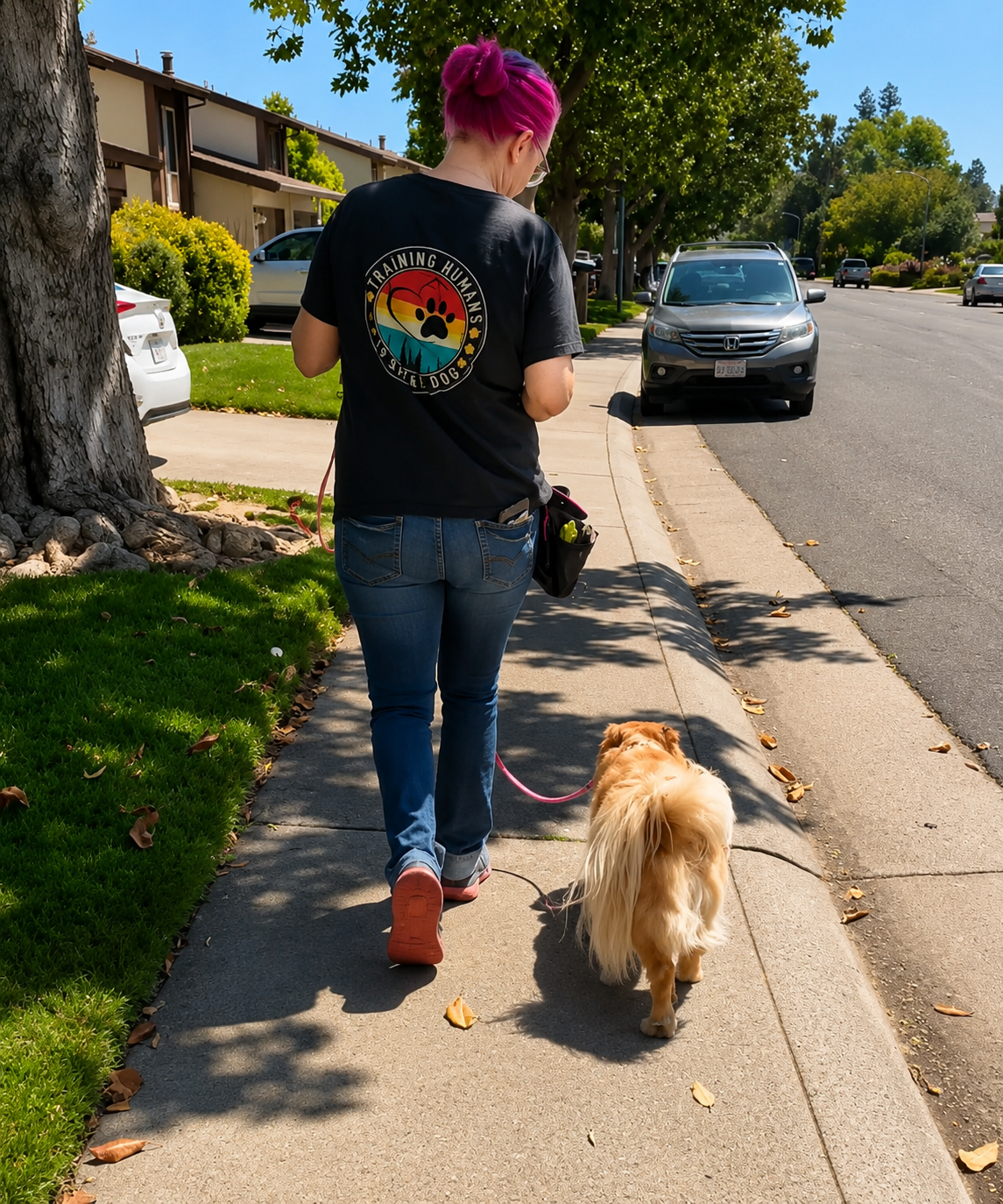
The truth is, the moment the leash goes on, I'm the pilot. Not "once we get outside." Not "once my dog calms down." The second that leash clips on, I am in control of where we're going and how we're getting there. Pilot mode is on in the house. It's on walking to the door. It's on before we've taken a single step outside.
When my dog is on a leash, I'm flying the plane the entire time. My dog might make the wrong choice — that's fine, that's allowed. We'll just do it again. And again. And again, calmly, until the right choice shows up. That's not me being a control freak. That's me being a steady, predictable pilot my dog can actually rely on.
The Biggest Thing I Control Isn't the Dog. It's My Own Head.
This is the part I wish someone had drilled into me sooner, and it's the part most owners completely miss.
To be in pilot mode, the thing I have to manage most isn't the leash, or the treats, or the dog. It's me.
When I'm piloting, my head is busy. I'm thinking about what my dog is thinking about. What he's feeling. What's happening in this room, and what's about to happen in the next one. And — this is the big one — I'm checking my own emotional state. Because here's the hard truth: if I'm uptight, anxious, and irritable, there is no way my dog is going to land in the right headspace. I'm the pilot. The whole cabin feels what I feel.
So I have to practice bringing my own energy down. Calm. Collected. I slow my breathing. I slow my heart rate. I deliberately think and move slower than the animal at the end of the leash. Because I want my dog's head to mimic my head, and the only way that happens is if we meet on the same energy level — and I'm the one who has to get there first.
Here's the drill, if you want one. Before the leash ever clips on, stop at the door and take three slow breaths — longer on the exhale than the inhale. That's it. You're not trying to feel zen; you're just dropping your gears down a notch so you're not starting the walk already wound up. If you feel yourself bracing mid-walk — shoulders up, jaw tight, that "here we go" flinch — name three things you can see. A tree, a parked car, a mailbox. It pulls your brain out of the what-if and back into the actual street you're standing on, which is exactly where your dog needs you to be.
If you've ever dealt with ADHD, you might know exactly the skill I'm describing. It's that thing where something high-pressure and high-stakes blows up in front of you, and somewhere inside you find the ability to just… slow down. Slow your head, slow your body, and breeze through the disaster that's unfolding. And then maybe afterward you fall apart a little — but in the moment, you found the calm. That's the muscle. That's the exact muscle a good pilot uses on the leash. And if that example does nothing for you because it's not your wiring — that's fine. The muscle is learnable either way. Anyone can practice it. I am going to breathe. I am going to slow my heart rate down. I am going to move slower than my dog. That's the job.
What the Opposite of a Pilot Looks Like
I've watched a lot of people walk dogs, and I can spot a passenger flying the plane from a block away.
The most common one is the anxious owner. They're so worried about everything that might happen — the dog around the corner, the jogger, the what-if — that their dog never gets to actually have a good time. The dog isn't reading the environment. He's reading his person, and his person is broadcasting that the world is a scary, high-alert place. So the dog goes on alert too.
The one that breaks my heart a little is the owner carrying baggage from a past dog. I have clients working so hard to wash away trauma from a previous relationship with a previous dog — and they bring all of it, without meaning to, right down the leash to the new one. But this dog is a fresh slate. He knows nothing about the dog that came before him, or what happened, or what you're afraid of. You cannot hand a brand-new animal your old fear and expect to teach him anything clean. The kindest thing you can do is set the baggage down as fast as you can.
That's why, honestly, a lot of my job isn't even about the dog. It's stopping the human, telling them to slow down, let's breathe, let's talk through this. Sometimes I have to be present for an owner's mental state before they can be present for their dog's — because an anxious pilot builds anxious habits, every single walk.
A Passenger Still Needs to Be a Dog
Now, before this turns into "control your dog every second of every day," let me be clear, because the balance matters enormously.
A dog who is only ever piloted — controlled in the house, controlled on the leash, controlled outside, controlled always — never learns how to do anything else. They get cabin fever. And worse, they never get to practice making their own choices, which means when a choice finally lands in their lap, they have no idea what to do with it.
I want my dog to experience decompression. I want him to get to be a dog — to sniff, to explore, to move through the world on his own four feet without me narrating every step. Because a dog needs to practice everything, including freedom. If we never set them up to make the right choice on their own, they'll never make it.
The way we get there is by managing the environment and guiding them through it like a good pilot would — so that the choices in front of them are mostly good ones, and they get to practice succeeding.
Where We Practice This Around Sacramento
A good pilot needs the right airspace, and that means giving your dog two different kinds of it.
For decompression — the easy, low-pressure, "just be a dog" time — I love the shaded HOA park around Crawford's Barn in the College Greens area, with its big oaks and quiet space near the American River. It's the kind of soft, calm environment where a dog gets to exhale.
When it's time to practice real long-line piloting — a long line is just a 15- to 30-foot leash that lets your dog roam while still attached to you — my dog gets freedom inside my bubble while I stay in command. The bubble is simple: he can sniff and wander anywhere he likes as long as he stays inside a rough circle around me, maybe fifteen feet out. That radius means he always keeps a little of his attention on where I am — which is the whole point. Larchmont Community Park on Stansberry Way is one of my go-tos for this. Fourteen acres of open grass and heritage oaks along the river give a dog room to move and make choices while I stay the pilot of the whole flight.
You can swap in whatever green space fits your own Sacramento neighborhood. The point isn't the specific park — it's making sure your dog gets both kinds of airspace: the freedom to decompress, and the structure to practice being piloted.
You're Not Raising a Pilot. You're Raising a Copilot.
Here's where I've landed on all of this.
The goal was never to control my dog forever. But it also was never to "graduate" him into being his own pilot, flying solo, making every call. That's not the deal.
The goal is a copilot.
A copilot is a dog who's earned a seat up front with me. He's learned enough, and trusts me enough, that I can hand him a little independence along the way. Maybe he's earned the right to go out in the backyard on his own and chase the rats around at night — because he's learned not to jump the fence, and he doesn't chew the sprinklers anymore. He gets to assist. He gets to make some of his own choices, the ones he's proven he can handle. We're a team.
But make no mistake: I am always the boss. The pilot doesn't hand over the controls. The pilot just gets to enjoy the flight a whole lot more once there's a good copilot in the seat beside him.
Want to Try It?
If you read all that and recognized yourself as the anxious passenger flying your own plane — you're not alone, and it's completely fixable. It starts with your breath, not your dog's behavior.
One honest caveat. If your dog has real fear, a bite history, or reactivity that's bigger than nerves, breathing calmer is a piece of the puzzle — but it's not the whole fix on its own, and you shouldn't have to white-knuckle it alone. That's exactly the kind of thing we work through together. Self-regulation makes everything else possible; it doesn't replace a real plan for a dog who needs one.
This concept comes from Kim Brophey and the Family Dog Mediation framework, and if it speaks to you, I'd encourage you to explore her work — her book Meet Your Dog and her Family Dog Mediation resources are a wonderful place to start.
Terra Ruiz is a Licensed Family Dog Mediator® and the owner of Wholistic Canine, offering dog training and behavior support in Sacramento, CA. If you'd like help learning to fly the plane with your own dog, reach out here — or text us at (916) 796-4925 (please text before calling).
The Pilot Walk: Frequently Asked Questions
What is the Pilot Walk?
The Pilot Walk is a concept from Kim Brophey's Family Dog Mediation framework. The idea is that when you and your dog move through the world together, you are the pilot and your dog is the passenger — you set the course, the pace, and the calm, and your dog gets to trust that someone competent is flying the plane. In practice, it's less about leash mechanics and more about you staying calm, present, and in charge of the whole experience.
Does being the "pilot" mean dominating my dog?
No. It's not about dominance or force — it's about leadership and trust. A good pilot isn't harsh; they're steady, predictable, and calm. Your dog isn't being bossed around, they're being relieved of a job they were never equipped to do. Most dogs relax noticeably once they trust that you've genuinely got the controls.
Why does my own anxiety affect my dog on walks?
Because your dog reads you before they read the environment. If you're tense, anxious, or bracing for something to go wrong, your dog picks up that the world must be a high-alert place and matches your energy. The single most powerful thing you can do on a walk is regulate yourself first. Try this: before the leash even clips on, stop at the door and take three slow breaths, longer on the exhale than the inhale. If you feel yourself bracing mid-walk, name three things you can see to pull your brain out of the what-if. Slow your breathing, slow your body, and move calmer than your dog — so their headspace can mirror yours.
When does pilot mode start?
The moment the leash goes on — not when you reach the sidewalk. Pilot mode is on in the house, on the way to the door, and before you take a single step outside. If your dog makes the wrong choice, you calmly do it again and again until the right choice shows up. The consistency is what makes you a pilot your dog can rely on.
Do dogs need free time too, or is it always pilot mode?
Dogs absolutely need both. A dog who is only ever controlled gets cabin fever and never learns to make good choices on their own. They also need real decompression — time to sniff, explore, and just be a dog. The balance is the whole point: structured piloting and genuine freedom, so your dog practices both.
Where can I practice this in Sacramento?
Any green space that fits your neighborhood works. For decompression, a quiet, shaded park like the College Greens HOA park near Crawford's Barn is lovely. For long-line piloting practice, Larchmont Community Park on Stansberry Way offers open space and oaks along the American River. The specific park matters less than giving your dog both kinds of environment.