
Is Your German Shepherd Trying to Run the Whole Show?
A Sacramento German Shepherd board & train trainer's take on the dog who won't stop running the show
I can almost always tell it's a German Shepherd before the person even says the breed.
"No one can come into my house."
"I can't walk him on leash — he looks really scary, and honestly I'm not sure if he'd bite someone or not."
"He alerts at everything. Bark, bark, bark, all day long."
"I can't get my German Shepherd to turn his brain off and calm down."
If that's the dog living in your house, I want to say two things right up front. You don't have a bad dog. And your German Shepherd is not broken. What you have is a dog doing exactly what he was built to do — in a world that never gave him a job, a boss, or a day off.
So before we talk about how to fix any of it, let's talk about what's actually going on.
First, Why Your Shepherd Is Wired This Way
When I assess any dog, I look at the whole animal through a framework called L.E.G.S.® — developed by Kim Brophey as part of Family Dog Mediation. As a Licensed Family Dog Mediator, it's the lens I bring to every dog I meet.
L.E.G.S. stands for Learning, Environment, Genetics, and Self. The idea is that no single one of those tells the whole story — behavior is what you get when all four interact:
- Learning — everything his past experience has taught him (like learning that barking makes the mail truck "leave").
- Environment — where and how he lives: your home, your street, the city around him.
- Genetics — what he was bred to do. For a German Shepherd, that's herding: watching, managing, controlling movement.
- Self — who this individual dog is right now: his age, health, energy, and internal state.
And with German Shepherds, the piece almost everybody skips right past is Genetics.
So here's your tidbit of breed education, because it explains so much.
German Shepherds belong to the Herding genetic group. For generations, these dogs were deliberately selected to control the movement of other animals — to watch, to manage, to push and gather and hold a flock together using intense focus, fast reactions, and a finely tuned sensitivity to everything moving around them (G). They were also bred to work in tight cooperation with a human partner (G) — which is exactly why a good Shepherd looks to you for direction, and why a Shepherd with no direction feels so lost.
That genetic blueprint doesn't switch off because he lives in a house in Sacramento now. Your Shepherd is still scanning. Still managing. Still watching for the thing that's "out of place." We just don't have any sheep for him to move (E) — so he goes looking for a job, and the modern world hands him a hundred fake ones: the mail truck, the skateboard, the dog across the street, the guest at the door.
None of that is your Shepherd being bad. It's a herding dog doing his genetically assigned work (G) in an environment that doesn't actually need it (E). Once you see that, everything he does starts to make sense — and a behavior that makes sense is a behavior we can finally help.
German Shepherds Are Always on the Clock
So your Shepherd is always talking. Always scanning. He alerts at the mail truck, the neighbor's gate, the leaf that moved wrong (G). To you it looks like chaos. To him, it's a shift that never ends.
And every time he alerts, the world cooperates with him. He barks at the mail truck (G), and the mail truck leaves. From his point of view, his strategy worked — so he files it away and does it harder next time (L). The guy at the door eventually goes away too. The dog across the street passes by. Over and over, your Shepherd is learning that running the show gets results (L), which is why the behavior gets louder and more confident over time, not quieter.
Walk into every situation and your Shepherd does one of two things.
He looks to you to tell him what to do (G).
Or he decides nobody's handling it — and he handles it himself.
That second one is where almost every problem you're dealing with actually lives. The barking at the window. The "scary" display on leash. The dog nobody can come visit. That's not a dog trying to dominate you. That's a dog who looked around, didn't see anyone flying the plane, and grabbed the controls because somebody had to.
"He Just Wants to Be the Boss" — Let Me Push Back on That
This is the line I hear constantly. He's so stubborn. He just wants to be the boss.
And sure — some dogs do reach for that job. But here's what people miss: being the boss is exhausting. Being in charge comes with a mountain of anxiety, and that anxiety is part of his internal state, his Self, in every one of these moments (S).
I always use Disneyland as an example.
Think about being the person in your group who's in charge of the whole Disneyland trip. You've got to get everybody to the rides on time. You pre-planned all the dinners. You're constantly counting heads, keeping the whole group moving in the same direction, making sure nobody wanders off. Is it a little empowering to be the one running it? Maybe. But mostly? It's exhausting. You don't get to enjoy the park. You're working the entire time.
Now flip it. Imagine you trust the person leading the trip. You don't have to track a single thing. You just get to walk through the gates, hop on the rides, and have a great day — because someone competent is steering and you know it.
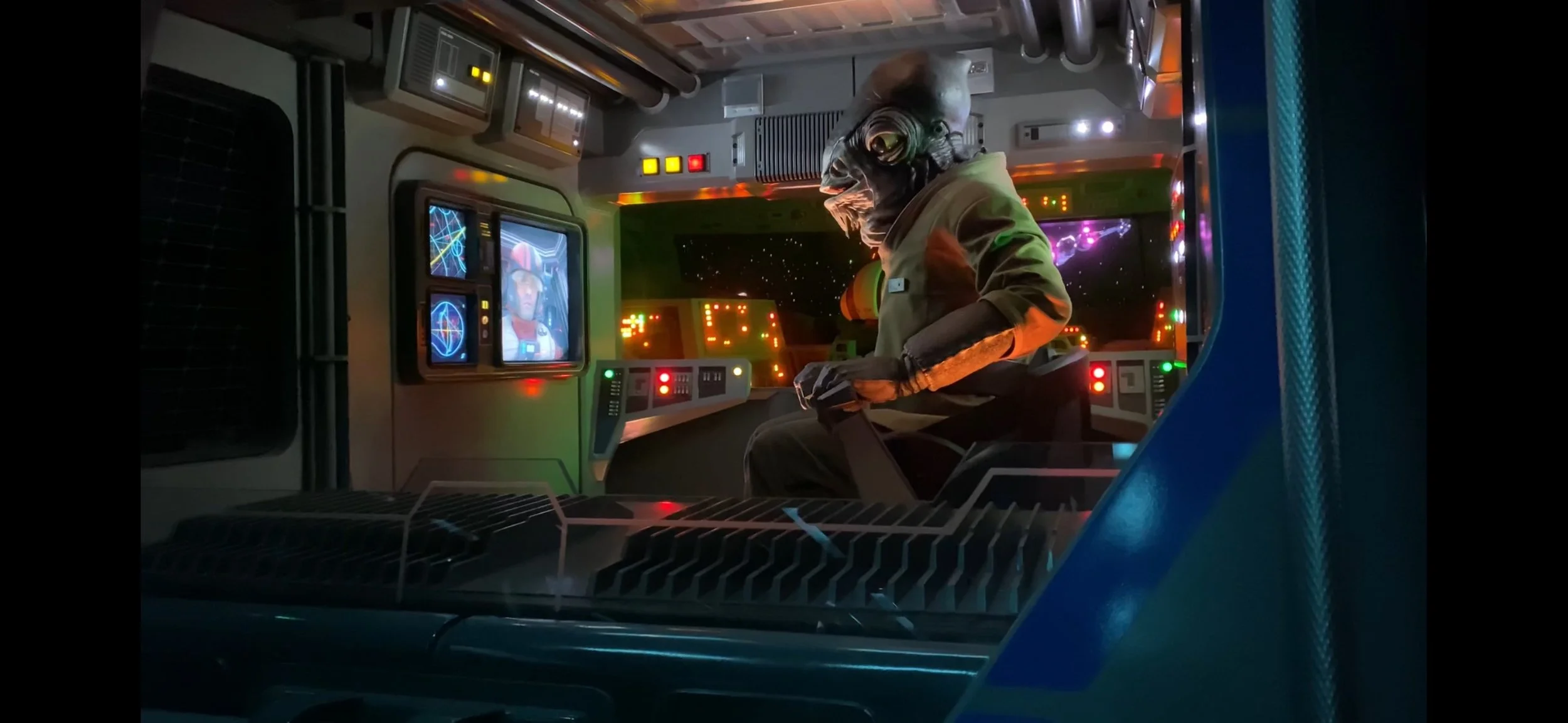
Star Tours felt fitting for this one: it's Disneyland and a pilot. A trusted one flying the ship — which is all your German Shepherd has ever wanted from you.
That's what your Shepherd actually wants. Not the boss job. The day off. He's not fighting you for control — he's covering a position nobody told him he was allowed to put down. The moment he believes you've genuinely got it, you'll watch the weight come off him (S).
So How Do You Become the One He Trusts?
In our world, that trusted tour guide has a name: the pilot.
There's a wonderful little concept from Family Dog Mediation called the Pilot Walk — the idea that when you move your dog through the human world (E), you're the pilot and your dog is the passenger. You fly with calm confidence, you set the pace, you handle the hazards, and your dog finally gets to relax in his seat because someone qualified is flying the plane. It's simple and it's worth two minutes of your time to read — you can find the Pilot Walk here.
I'll be honest with you about something. When I walk a dog, I am always the pilot. It actually feels strange to me to walk a dog where I don't have to be. Even with my own dog out in front of me on a long line in an open field, I'm the one deciding where we're going, how we're getting there, and how fast.
That field is a good example, because people misunderstand it. My dog gets a lot of freedom out there — but he has to stay inside my bubble. It's a big bubble, maybe fifteen feet around me, and inside it he's free to sniff and move and explore however he wants (E). I'm not micromanaging every step. But he does have to stay within that fifteen feet, and that means he always has to keep a little bit of his attention on where I am.
That's the whole thing right there. Freedom, inside a boundary I'm holding. Independence, with me still flying the plane. That's what a Shepherd can finally exhale into.
Why This Clicks in Board & Train
Here's the catch: a German Shepherd does not learn to trust a pilot in one rushed lesson a week.
He learns it the way trust actually gets built — through repetition, consistency, and day-after-day proof that the person in charge knows what they're doing (L). You can't cram that into an hour on a Saturday and expect a dog who's been running his own show for two years to suddenly hand over the controls.
That's exactly why our Board & Train Immersion Program works so well for this breed. Our lead trainer, Alex, runs the bulk of our board & trains, and Shepherds are right in her wheelhouse. Your dog lives and learns in a real home environment (E), 24/7, with someone flying the plane well — every walk, every doorway, every "who's handling this?" moment — until trusting a competent pilot stops being a training exercise and just becomes how he moves through the world (L).
And then we hand you the controls. Because the goal was never a dog who only listens to us. The goal is your dog, in your home, finally able to put the job down — because he trusts you to fly.
Stop Trying to Win the Power Struggle
If you take one thing from this, let it be this: your German Shepherd was probably never trying to be the boss.
He was just tired of being the only one willing to do the job.
Take the job back — calmly, consistently, like a pilot who's done this a thousand times — and watch what happens to that "stubborn," "scary," "won't-settle" dog. Most of the time, underneath all that noise, is a dog who's been waiting his whole life for someone to tell him he can finally relax and enjoy the park.
Terra Ruiz is a Licensed Family Dog Mediator® and the owner of Wholistic Canine, offering German Shepherd board & train and behavior support in Sacramento, CA. If you've got a Shepherd who's running the whole show and you're ready to take the job back, reach out here — or text us at (916) 796-4925 (please text before calling). Let's look at what your dog is really trying to tell you.
German Shepherd Board & Train: Frequently Asked Questions
How long does board & train take for a German Shepherd?
For most German Shepherds, plan on four weeks. It's the ideal — the most polished, the most thorough, and it sends your dog home in the best shape. We also offer two- and three-week programs: two weeks is best for polishing skills your dog already has, and three weeks is great for building a solid foundation from scratch. But if you want the prettiest result, four weeks is the one to bank on. You can see all three packages on our Board & Train Immersion page.
How much does board & train cost?
All of our current board & train pricing is listed right on our Board & Train Immersion page. Financing is available on the four-week program — just keep in mind that if you finance, the financing company's fee gets added on top of our listed price, so plan on the website cost as your baseline.
Can board & train help a reactive or aggressive German Shepherd?
Absolutely — this is exactly what it's for. A big part of why it works is the new environment itself. The triggers your dog reacts to at home simply aren't here, so we get a clean slate to teach him how to handle situations differently and build good habits from the ground up, without the same old patterns firing off. We start every dog with an honest assessment so we know exactly what we're working with. If reactivity or fear is your main concern, you can also read more about how we approach it on our Reactive & Fearful Dog page.
Where does my dog stay during board & train? Is it a kennel?
No kennel. Your dog lives in the house with us — crated in the home at night — so he learns real house manners without all the stress that comes with kennel life. We take a limited number of dogs at a time on purpose, so every dog gets care and training tailored to them.
Who actually trains my dog?
You'll know exactly who's training your dog, because you'll have already spoken with them and talked through your whole training plan together. It'll be Alex or Terra — and German Shepherds are right in their wheelhouse. You can meet the team here.
What results can I realistically expect when my Shepherd comes home?
Your dog will come home with much better communication with humans and the ability to actually function in your home — to lie down, settle, and relax instead of being "on" all the time. Better behavior on leash is a huge piece of what we work on, and we'll put a protocol in place for having people over. We don't make promises, because the truth is it depends on the dog and on you. Your dog is always learning — if you're not teaching him how to handle a situation, he's teaching himself, and he'll usually pick whatever's easiest in the moment, not what's best in the long run. Our job is to make sure the right lessons are the ones that stick.
What happens after my dog comes home?
This is the part that matters most. Think of it like learning a new language: by the end of the program, your dog has a new language — and we've taught it to you, too, so you can speak it together. But if you learn a language and never use it, you lose it. The same is true here. The follow-up lessons are built in to set you up, and the dogs who hold onto their training are the ones whose owners keep speaking the language with them at home.
Do you offer German Shepherd board & train near me in Sacramento?
Yes. Wholistic Canine offers German Shepherd board & train and behavior support throughout the Greater Sacramento area. The best place to start is a free intro call — or text us at (916) 796-4925 (please text before calling).